The intrafaith conversation is not a necessity for Christians alone. Divisiveness occurs in most, if not all, all religions. I once asked a Jewish friend to name the biggest issue that divides Jews, and she immediately replied, “Israel.”
So I was intrigued by the title of this article on the GetReligion website: “American and Israeli Religious Infighting: Could It Destroy the World’s Lone Jewish State?”
Surveys contrasting the political and religious views of American and Israeli Jews are produced with such frequency as to make them a polling industry staple. In recent years – meaning the past decade or so – the surveys have generally shared the same oy vey iz mir (Yiddish for “woe is me”) attitude toward their findings, which consistently show widening differences between the world’s two largest Jewish communities.
Compare, for example, the vast differences on moral and cultural issues between the institutionally liberal American Episcopal Church and the traditionalist Nigerian Anglican church leadership. That, despite both national churches belonging (at this moment in time) to the same worldwide Anglican Communion.
Why should the Jewish world be any different? It’s like the old real estate cliche, location – meaning local history and circumstances – is everything.
Religion is just not the broad intra-faith connector some would like it to be. Often, if fact, it serves to fuel intra-faith rivalries rooted in strongly held theological differences.
Judaism even has a term for it; sinat chinam, Hebrew for, translating loosely, a “senseless hatred” that divides Jews and can even lead to their self-destruction. Intra-faith Jewish differences, however, take on an added layer of global importance because of the possible geopolitical consequences they hold for the always percolating Middle East.
You can read the rest of the article here.


 Today’s intrafaith question:
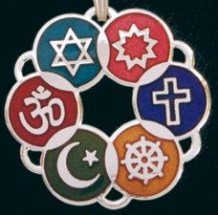 It’s the passage that’s always brought up when Christians get together to talk about interfaith relationships. It is one of THE intrafaith questions. What do we do about “I am the Way, the Truth, and the Life. No one comes to the Father except through me”?
 I’m feeling extremely honored to have been invited to be interviewed for a website called
  they’ve created . . .
 . . . it proclaims “They can’t all be true.”
 On Pentecost Sunday 2007, we had our first Pluralism Sunday at First United. In fact, that was the very first ever Pluralism Sunday. The event was initiated by Rev. Jim Burklo, a pastor in the United Church of Christ and now Associate Dean in the Office of Religious Life at USC. A long-time proponent of progressive Christianity, affiliated with The Center for Progressive Christianity (now
  religion is superior to all others. We grow closer to God, grow deeper in compassion, and understand our own tradition better by honoring and exploring the world’s religions. Many if not most people think that in order to be a Christian, it’s necessary to believe that Christianity is the only valid way to salvation, and that other religions are inferior at best and evil at worst. But Pluralism Sunday spreads good news: there is a way to be Christian without making this prideful claim, which has been the cause of so much inter-religious division and misunderstanding. Pluralism Sunday takes a big step beyond mere “tolerance” of other religions, and affirms that other faiths may be as good for their adherents as our faith is for us.
 The Interfaith Pastor