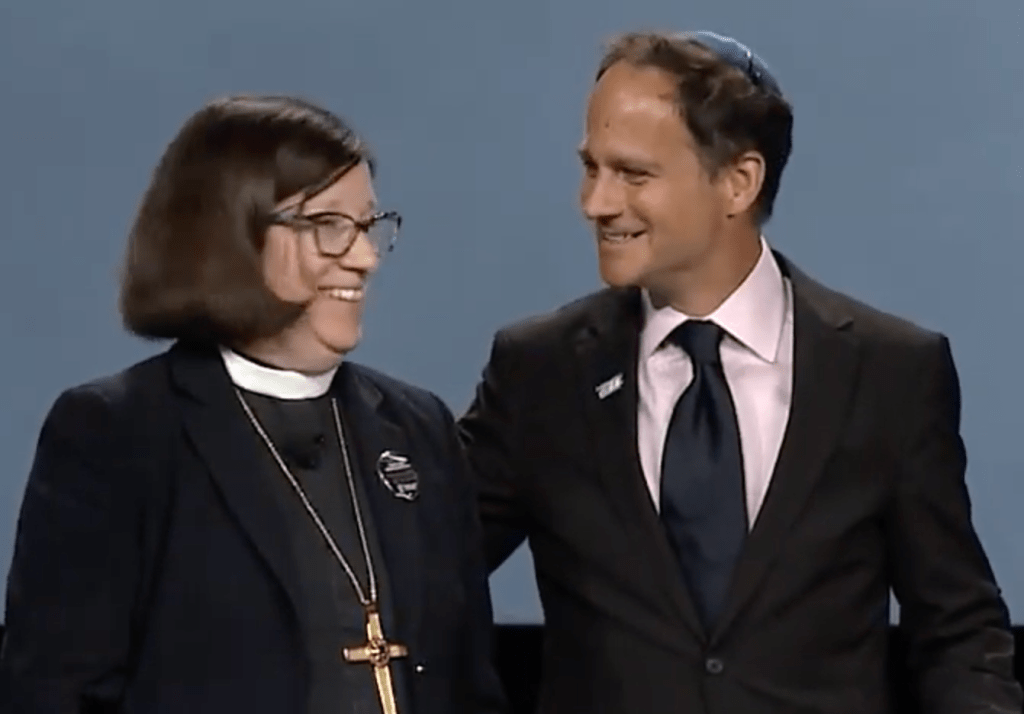
 A lot happened at the Churchwide Assembly of the Evangelical Lutheran Church in America (ELCA) last week. Some of it even made national news – and rightly so.
What you might not have seen in the news, but which is a very big deal, is all the interfaith activity. One of the matters brought to the attention of the 927 voting members in attendance was the relationship between Lutherans and Jews. It has not always been a good one.
Years ago, a co-worker who heard I was about to go off to the Lutheran seminary, exclaimed, “I hate Lutherans!” It turned out that her husband was Jewish and she’d read the ugly things that Martin Luther had written in some of his later writings. At that time, I was only barely cognizant of this part of my religious heritage. I didn’t know how to respond.
Many years later, when a group of college students visited my congregation on a tour of local religious communities, one of the first questions they asked was about Luther and the Jews. This time I was more prepared and, thankfully had something positive to contribute.

For one thing, I had studied Church History and Reformation Studies under Dr. Eric Gritsch at the Lutheran Theological Seminary at Gettysburg (now part of United Lutheran Seminary) and was aware of his active involvement in the Christian-Jewish dialogue. And although his book, Martin Luther’s Anti-Semitism: Against His Better Judgment, was published long after my seminary days, I do remember him talking about this neuralgic (a favorite Gritsch word) part of our history.
In 1994, “Declaration of the ELCA to the Jewish Community” was released. And in 1998, Guidelines for Lutheran-Jewish Relations. Both of these documents are important milestones. But, in my opinion, what took place at the Assembly took our relationship with our Jewish siblings to a new level. Members of the ELCA Consultative Panel on Lutheran-Jewish Relations led voting members and visitors in litany based on the 1994 statement, including this paragraph:
In the spirit of that truth-telling, we who bear his name and heritage
must with pain acknowledge also Luther’s anti-Judaic diatribes
and the violent recommendations of his later writings against the Jews.
As did many of Luther’s own companions in the sixteenth century,
we reject this violent invective, and yet more do we express
our deep and abiding sorrow over its tragic effects on subsequent generations.
In concert with the Lutheran World Federation,
we particularly deplore the appropriation of Luther’s words
by modern anti-Semites for the teaching of hatred toward Judaism
or toward the Jewish people in our day.
Watch the entire litany here.
And then, Presiding Bishop Elizabeth Eaton introduced Rabbi Jonah Dov Pesner, director of the Religious Action Center of Reform Judaism and senior vice president of the Union for Reform Judaism. His address to the assembly was incredible!
Watch it here. You’ll be glad you did!
I’ll be writing about more of the interfaith and intrafaith aspects of the assembly. But I thought this deserved its own post. Anti-Semitism has deep roots in American history, but in 2018, anti-Semitic attacks were near record highs.
All Christians should stand in solidarity with our Jewish siblings.
Lutherans should be in the forefront.
After watching the news from Churchwide Assembly, I believe – by the grace of God – we just may be.
 I will admit that the past few days have left me with a mix of emotions from depression to anger and back again. Yesterday, it was anger mixed with just plain grouchiness. Plus I was stressed because I wasn’t getting enough work done due to (see above).

 The Interfaith Pastor