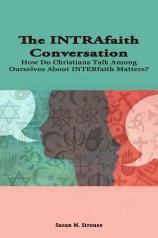
I am happy to report that, so far, The INTRAfaith Conversation has a 5-star rating on Amazon. Below are the five reviews (in reverse chronological order) that have been submitted. And yes, I would love more! If you’ve read the book, please let me know what you think. After all, it’s supposed to be a conversation.
Giving Peace a Chance
By June on September 16, 2016
This is an important book for our times. It will be essential reading for all people of faith and those in our country who experience spirituality outside the faiths. Strouse explores what it means for Christians to dialogue together with the beliefs of other world religions, with other denominations and within one’s church. This book ushers us step by step into a process towards unity of love and respect that enables us to discover how to live the love in which we believe as well as to evolve from a rote worshipper to a discerning believer. She shows how Christians can accept and respect beliefs of others, find common ground and evolve in our own faith expression to prevent exclusionary or irrelevant evangelism. It reads fluidly, is serious yet entertaining, logical in light of the history presented, compassionate, educational and inspiring. Strouse has addressed something so timely, necessary (in light of world terrorism), and helpful in understanding what is happening in our declining mainline churches. For the future of the Gospel and the survival of the world, this should be read in our churches for breathing life into our faith, in homes for raising generations of tolerant and inclusive people, and in seminaries as required reading to prepare pastors for encounters / interactions of cultures they will face in their neighborhoods as well as to assist them in utilizing the processes presented. Whereas missionary work historically meant traveling to convert indigenous peoples, in America today we live amongst a multitude of spiritual / religious faiths which is now our fertile field for outreach, not necessarily for conversion but for establishing and nurturing peace. If this is a time in our world for the church to evolve, let us start with ourselves, those in our faith and others of all faiths to develop and share understandings. The world awaits a revolution of joy and open hearts.
Interfaith Chaplain Resident August 28, 2016
as Christians can better understand our own faith
This book was written so that in this pluralistic world in which we now live, we, as Christians can better understand our own faith, and the issues involved with interfaith dialogue, so that we might be more comfortable being in conversation with our neighbors who are not Christian. While this book was written to the larger interfaith dialogue within the broader culture, I find the insights in this book to be very applicable in the clinical pastoral care setting in which I minister. I hope the saying is true that we are judged by the company we keep so by keeping company with this book I might be somewhat smarter than before I read this book. I thoroughly enjoyed reading “The INTRAfaith Conversation”. Susan’s writing style is engaging, easy, and conversational, yet theologically intelligent.
Five Stars by Russell H. Miller June 22, 2016
Expertly laid out providing a roadmap for a much needed dialogue.
Inevitably, profound questions arise out of respectful encounters with people of religions other than our own. Many who have been involved in cooperative engagements with people of other faith traditions discover that it is often easier to talk with people of a different religion than it is with the person sitting next to you in your own congregation. For others, the struggle is within, as in the case of Elsie L., a parishioner in Buffalo. After a church session in which a Hindu woman active in interfaith activities had spoken to the group, Elsie spoke to Pastor Strouse. “If I accept the Hindu path as equal to Christianity,” she said, “I’m worried that I’m betraying Jesus.”
Years of wrestling with that question and similar ones resulted in Strouse’s new book, The INTRAfaith Conversation: How Do Christians Talk Among Ourselves about INTERfaith Matters? In it, Dr. Strouse addresses the challenges that the increasingly interfaith realities of today present to Christians, and invites reflection on how Christian theology and identity might be shaped and even strengthened by cooperative interfaith relationships.
Blending personal stories, thoughtful reflection on the changing face of America and pastoral concern, The INTRAfaith Conversation invites readers to understand and appreciate just what doing Christian theology means in today’s multi-religious world. The book’s sections reflect the breadth of Strouse’s focus: dealing with the new religious context; what it means to think theologically as a comunity; tolerance, exclusivism, inclusivism, and pluralism; personal experience; and pastoral and leadership issues for congregations entering the interfaith world.
 I returned to the Jersey shore this summer. I hadn’t been there since 2001. In fact, I was in Ocean City on 9/11/2001. As I watched the towers fall on TV, I could see fighter planes and helicopters flying up the coast. It’s not something you forget. Of course, others have more horrific and tragic stories to tell. But for those of us who were old enough to be aware of what was happening at the time, we’ll always remember where we were on that day. And we should remember: those who died, their families, the first responders, the ongoing after-effects of trauma.

 I’m happy to announce a return visit from Elaine Donlin of the
  Next up in our summer of “religion and politics” is Laura Magnani from the Quaker tradition. Laura is director of the American Friends Service Committee’s Bay Area Healing Justice Program in California and has worked on criminal justice issues for over 35 years. She wrote


 Well, it’s over. The 28th annual gathering of the
  orkshop was on Tuesday, but on Monday I got some great publicity. During the discussion at a workshop on interfaith hospitality, someone spoke up and said, “What we really need to have is an intrafaith dialogue.” I almost jumped out of my seat as I raised my hand to jump in and tell everyone about the opportunity to do just that – and buy the book as well!
 Then we broke into small groups and everyone got a chance to share their own stories and struggles with members of their own tradition. Finally, we began to strategize about how to create an intrafaith conversation when we got back home.
 I don’t know if anyone will do that. But I believe that, at the very least, the issue was put out onto the table, and participants went away with some resources and hopefully lots to think about.
 I first met Dolores White back in 2002 when I had just arrived in Berkeley. I’d met Paul Chaffee from the Interfaith Center at the Presidio and was invited to a board meeting. Somehow I found my way from the East Bay to the far side of San Francisco (the Presidio is not easy to get to on public transportation and my car was still back in Buffalo). I’ve gotten much more savvy about navigating the streets of San Francisco, but back then I wasn’t sure how I’d ever find my way back home.
 This will be the first gathering in Mexico and there will be an emphasis on Indigenous Peoples and their relationship to the land/struggle for land and water rights. The theme of the conference this year is Sacred Space. According to the planners, we’ll be looking at sacred space in the widest sense possible – our inner sacred space, the space we create together in relationship, our worship spaces, holy places, the land and the earth and the universe as sacred. Also, my workshop proposal was accepted, so I’ll be leading my first interfaith intrafaith conversation!
 I’m particularly happy to welcome two guest speakers this coming Sunday. Ed Driscoll and Jim Lichti are members of
 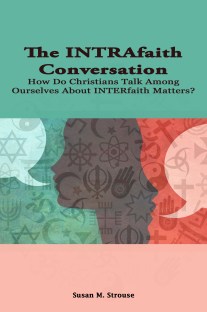 nevitably, profound questions arise out of respectful encounters with people of religions other than our own. Many who have been involved in cooperative engagements with people of other faith traditions discover that it is often easier to talk with people of a different religion than it is with the person sitting next to you in your own congregation. For others, the struggle is within, as in the case of Elsie L., a parishioner in Buffalo. After a church session in which a Hindu woman active in interfaith activities had spoken to the group, Elsie spoke to Pastor Strouse. “If I accept the Hindu path as equal to Christianity,” she said, “I’m worried that I’m betraying Jesus.”
 The Interfaith Pastor