Blog

  • Life Among the Ruins

    screen480x480I will admit that the past few days have left me with a mix of emotions from depression to anger and back again. Yesterday, it was anger mixed with just plain grouchiness. Plus I was stressed because I wasn’t getting enough work done due to (see above).

    Then a wondrous thing happened. About forty young people arrived at church along with their teacher to learn about Lutherans. The  group was from the University of San Francisco, a Jesuit institution. The class is “What Is Catholicism?” and is a requirement for all students. So it was a pretty mixed bag of Catholics and Protestants (no Lutherans, though). They were visiting various Christian churches and our place on the schedule followed a field trip to an Eastern Orthodox church.

    Their teacher had emailed me earlier to confirm and had warned me that his class was feeling pretty upset by the election results, so we might want to deal somehow with that. So my colleague, Anders Peterson from Middle Circle, and I set up a space with a few candles and planned some songs and readings that we could use, depending on the needs of the group.

    The students arrived with the kind of energy that only young college students have. Once we got them all settled in, we read a statement and call to action from The Charter for Compassion:

    the invitation has arrived
    to step into our courage
    and our full humanitycharter_brand_transp_orange_medium
    from this day forward
    the harm can only unfold
    and multiply and spread
    with our silence
    with our consent
    with our participation
    we will not be silent
    we do not consent and
    we will not participate
    in legitimating violence, lies and division
    the love that we are
    the love that connects us all
    the love that bends history
    even in this dark moment 
    towards liberation 
    We are one 
    we are many and
    we are one
    it is time 
    dear friends 
    the revolution of love
    must be completed 
    And it is only possible 
    if on this day
    we commit our lives 
    to walking the hard road 
    because there is now only one way forward 
    So it was a good time of camaraderie and healing. But then it also became a real example of  how intrafaith conversations can work. I told my Lutheran faith story; Anders told his. Then we asked if the students had any questions. And they did.
    For example, they wanted to know:
    • the process used in Christian-Jewish dialogues that led to repudiation of anti-Semitic writings of Martin Luther and expressions of sorrow and repentance
    • the differences in Communion practices between Lutherans and other Christian churches – what kind of bread, for example
    • who was allowed to receive Communion
    • our understanding of baptism
    • why we don’t use the Nicene Creed (which is a First United decision, not a pan-Lutheran one)
    • could Lutheran ministers get married

    There were many nods of agreement, but there were also a few exchanges of differences, for instance in the use of the Creed.

    But it was all done with good will, curiosity, and respect. A real intrafaith encounter! It warmed my heart on an otherwise bleak day. People of differing backgrounds and practices coming together to learn about one another can only contribute to peace in the world.

    A revolution of love! Yes!

    peace_sign_button-rb0034827ad574947b408515573ac7bfd_x7j3i_8byvr_324

  • Is Religious Diversity Making Us Less Religious?

    imagesAccording to a recent article in the Christian Century (Sept. 28, 2016), one reason America has become less religious is our religious diversity.  It goes on to say:
    Although religious pluralism is not necessarily the cause of declining religiosity, it does expose people to ideas and prices that challenge their faith. 

    All I have to say is, “Yes! Yes! Yes!”

    The story of Elsie (see blog post from December, 2015) is a perfect illustration of the above quote – and further rationale for engaging in the intrafaith conversation.

    This is not simply an interesting add-on to the work of ministry today. It is integral to the message we preach and preach, the mission we promote, and the church we want to become.

    A big thanks to all of you who are reading the book in your churches and passing it along to friends.  Keep the movement going!

  • The Intrafaith Landscape: A New Reformation

    semper-reformanda1About every five hundred years the Church feels compelled to hold a giant rummage sale. –
                                                                Bishop Mark Dyer

    Change is happening within American Christianity. New ways of being church are springing up all around. Unlike the “worship wars” of previous decades, which pitted traditional and contemporary proponents against one another, the movement today is not so easy to classify. Terms such as “emergent,” “post-denominational,” “post-modern” and “progressive” attempt to describe the Christian scene and the movements going on within it. Each of these categorizations contains within itself a wide variety of interpretations of what it really means.

    All of these are taking part in a “giant rummage sale,” as Bishop Dyer so brilliantly describes it. However, it’s clear that we’re not all in agreement about what we should keep and what we should give away. Perhaps it would be more accurate to say that we’re in the process of getting ready for the sale. If you’ve ever held a yard, garage or rummage sale, you know the work that goes into putting it together. The first thing you have to do is look over all of your stuff with a critical eye. As you look at each cherished possession, you ask: Do I want to keep this? Is it still useful? Does it still fit? Does it still work? If the answer is ‘yes,’ the decision is easy; it’s a keeper. And if ‘no,’ to the sale it goes.

    It gets a bit more complicated when you have an item that is tarnished, worn or outdated but you think there just might be some life left in it. You have to ask yourself if maybe, if it were cleaned up, restored or reworked, it could still be of value to you. A dusty old heirloom might just turn out to be a new treasure.

    So it is in present-day Christianity. We’re looking with critical eyes at social issues, liturgical forms, biblical interpretations, theological teachings and the use of language. However not all churches necessarily deal with all of these, nor would they all agree. For example, a few years ago I attended, along with some members of my current congregation, a conference on the emerging church. First United considers itself to be a progressive congregation, committed to the use of inclusive language for humanity and expansive language for God. At First United’s rummage sale, we had examined patriarchal language and decided that it had to go. So we were quite surprised by the lack of inclusive language used at the conference. We realized that we are all making different value judgment about our treasures. This is the reformation that is happening all around us. Old ideas are being reexamined, transformed or rejected; new ones are emerging.

    Why is all this change happening now? Taking her cue from Bishop Dyer, the late Phyllis Tickle posited that we are in this current “giant rummage sale” simply because it’s time for one. In The Great Emergence: How Christianity Is Changing and Why, she outlined the upheaval that has occurred every five hundred years since the time of Jesus.

    The Protestant Reformation began in the 16th century. The 11th century saw the Great Schism, which split the Eastern and Western Churches. In the 6th century, the Roman Empire collapsed and Europe entered the Dark Ages. All of these upheavals included  both societal shifts and theological issues, just like we are experiencing now in the 21st century.

    What I find most helpful about Tickle’s theory is that what we’re going through is normal. That means we can go about being creative and hopeful, rather than hidebound and anxious. This is good news because the church has been anxiety-driven for quite a while. Our outreach efforts have been fueled by the decline in membership in Christian congregations. Pundits have been writing ad nauseam about the reasons for this. The latest trend is expounding on the characteristics of the Millennial generation and how the church can reach out and reel them in. Some of these same “experts” also tell us how to appeal to those who are “spiritually independent” (a more positive way of saying “spiritual but not religious” or “none”) all around us.

    Don’t misunderstand me: I’m all in favor of doing outreach to those searching for a way to explore their spirituality and to those with no church home. However, as a veteran of the church growth movement of the 1990s, I know the pitfalls of easy characterizations and easy solutions. The experts told us then that we had to adapt to the needs of Gen X and  if we’d just follow their instructions to the letter, our churches would grow. We actually bought a program like this in my former congregation.

    We received a big binder of step-by-step instructions – and a church growth consultant! We envisioned our little congregation in a Northeast rustbelt city grow1381770_10201458045106340_670873635_ning by 200-400%. Looking back, the idea was ludicrous. We were a mainline church in a city itself in decline. But even more ludicrous was the advice of our “expert” consultant. He took one look at our building, sitting on the corner in the middle of two lovely lawns with large shade trees, and declared that we needed to rip out the trees and the laws and put in parking lots. Rule #1 of church growth: you have to have a parking lot. Needless to say, we did not tear up the lawns. They provided play space for our preschool and summer program. They were places of hospitality for neighborhood gatherings, such as the annual National Night Out. The trees provided shade and beauty, as well as nesting places for birds. We were a green space in a city neighborhood. Should we really have “paved Paradise and put up a parking lot.?”

    I’m happy to report that the congregation is still there, some twenty years after our venture into church growth. The congregation is still small, but they’ve partnered with a congregation in the suburbs and are doing vibrant, creative ministry together. When I returned for their 90th anniversary celebration last year, one of the things I enjoyed most was the cookout held out on the back lawn under that big beautiful tree. Despite my obvious feelings about the experience, I learned an important lesson: there are no one-size-fits-all answers to the questions of doing ministry in different settings.

    Issues may change. Culture may change. The task of the church is to live out “ecclesia semper reformanda est” (“the church is always to be reformed”). In reaching out to Millenials, spiritual independents, the “church alumni society*,” we must take up the challenge in our own time. The inclusion of interfaith and intrafaith is an essential part of living out this challenge.

    Imagine my delight in arriving at the Graduate Theological Union in Berkeley to work on my doctorate in this area and discovering a course called “Martin Luther and Buddhism”! In the class I became immersed in a fascinating convergence of Lutheran and Buddhist teaching. I was mainly interested in learning about a tradition other than mine. After all, I knew about Lutheranism. But to my surprise, the primary benefit of the course for me was an invigorating renewal of Luther’s theology of the cross. Through study of the Buddhist concept of dukka (suffering), I was able to reimagine the central symbol of Christianity that I had not been sure I could espouse any longer. My rummage sale item could still be a keeper.

    • What is an aspect of the Church that you would like to give away?

    • What do you definitely want to keep?

    • What are some components that you think might be redeemable with some work?


    *Phrase coined by Bishop John Shelby Spong to describe those who have left the church


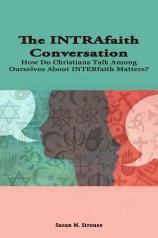
    (excerpted from The INTRAfaith Conversation: How Do Christians Talk Among Ourselves About INTERfaith Matters?_


  • New Review of “The INTRAfaith Conversation”

    she likes it“As a Christian who has been engaged in the interfaith movement for over 25 years, I found myself intrigued by The INTRAfaith Conversation: How Do Christians Talk Among Ourselves About INTERfaith Matters? (2016). Susan Strouse’s book explores the importance of intrafaith conversations as a path to deeper and more meaningful interfaith conversations. Strouse writes from her personal experience as a Lutheran pastor introducing interfaith to her own congregation, sharing the stories she has collected along the way, supplemented with a depth and breadth of remarkable research.”

    Read the rest of the review in the October edition of The Interfaith Observer here.

    Kay Lindahl, founder of The Listening Center, is a skilled presenter and workshop leader1472002254936 who teaches that listening is a sacred art and a spiritual practice. She is the author of the award winning book, The Sacred Art of Listening. Kay is also a dedicated spokesperson for the interfaith movement and is on the Board of Directors for Women of Spirit and Faith, an Ambassador for the Parliament of the World’s Religions, a past trustee of the Global Council for the United Religions Initiative, and is Past Chair of the North American Interfaith Network. Lindahl has presented her work in diverse settings – local, regional, national and international. Locally she has created programs, board retreats, training for spiritual directors, in-service training for non-profit organizations and lectures on college campuses. She is the founding president of the The Interfaith Observer (TIO) Board of Directors.

    1fc443a0-7592-4244-b76c-b7ecc5740c0b

  • The Professor Wore a Hijab in Solidarity – Then Lost Her Job: An INTRAfaith Case Study

    The New York Times Magazine ran an article in its October 13, 2016 edition entitled “The Professor Wore a Hijab in Solidarity – Then Lost Her Job”. It’s the story of Larycia Hawkins, the first female African-American tenured professor at Wheaton College, an evangelical Christian liberal arts college. Dr. Hawkins lost her job after a controversy that began with her intention to wear a hijab during the Advent season, in solidarity with Muslims.

    You can read the article here. It’s an important story on many levels, not the least being race and gender. But my point in posting  it here is that it’s a perfect example of the necessity of intrafaith discussions among Christians of differing theological perspectives.

    Dr. Hawkins identifies as a Christian. Her Christianity allows her to make the statement she made by wearing the hijab. The administration and many alumni of Wheaton College have a different interpretation  of Christianity. Many students and faculty members were understandably upset with Dr. Hawkins’ “mutual place of resolution and reconciliation”  departure.

    Rather than dismissing this popular, well-qualified educator, would it not have been wiser to use the controversy as an opportunity for an intrafaith conversation?

  • Help Me Create a Christian Float for an INTRAfaith Parade

    macy_s_thanksgiving_marching_band_-_vertOur diverse religious environment can be disconcerting for many people. Author Kenneth J. Gergen once described the disorienting effects of pluralism as that of a “relentless parade.”

    But another author, Theodore Brelsford turns the negative-sounding observation into an opportunity for imagination and creativity:

    It occurs to me that one way to respond to a parade which seems relentless is to build a float and join in.

    So OK, let’s do it! Let’s say we’re building our float. In the festive context of the celebration of diversity, what should our Christian float look like? What symbolic images might we in63c6ac4ee1a4cedb05b14099ed8a44fcclude, and what is it that those symbols symbolize?”

    I tried this out at my workshop at the Parliament of the World’s Religions last October. After an hour of telling stories and surfacing issues and questions, we began putting symbols for our float up on newsprint. It was a lively, fun exercise. Not everyone agreed on each symbol – not even a cross. Someone wondered if we might have to have more than one float. Unfortunately, time ran out. These conversations do take time. But I discovered that Brelsford’s metaphorical float idea is a good one.

    rmt16773So what’s your symbol? Let me know what image conveys to you the heart of the Christian message. Maybe it’s a traditional church-y one. Or maybe it’s something no one would ever expect to see in a  stained glass window.

    Attach a picture if you have one – and a little explanation of why this symbol is meaningful to you. If I get enough, maybe I can create an intrafaith parade right here on this blog!

    To get us started, here’s one of my favorites. One of the gospel of John’s “I am” sayings, has Jesus s2492729_origaying “I am the vine; you are the branches.” Of course, in these “I am” passages, John wants to connect Jesus to the great “I AM” of Exodus.

    I don’t want to get into christological matters right now (happy to at other times, though!); I don’t have to believe in the formulations of the Nicene Creed  in order to appreciate the metaphor. What I see in the vine imagery is that we are all connected to the Source of Life – and we are all interconnected with one another.  So a vine goes onto the float.

    Now – what say you?


    Gergen, Kenneth J., The Saturated Self: Dilemmas of Identity in Contemporary Life (NY: Basic Books, 1991), quoted in Theodore Brelsford, “Christological Tensions in a Pluralistic Environment: Managing the Challenges of Fostering and Sustaining Both Identity and Openness,” Religious Education, (Spring 1995): 176.

    Brelsford, Theodor, “Christological Tensions in a Pluralistic Environment: Managing the Challenges of Fostering and Sustaining Both Identity and Openness.” Religious Education, 90, no2 (Spring 1995): 174-189, 188.


  • Not That Kind of Christian!

    backto3It’s a tough time to be a Christian. More and more, we’re being forced to choose what kind of Christianity we shall be identified with. Evangelical, fundamentalist, progressive, traditional, conservative, liberal: the labels aren’t that simple.

    In this presidential election campaign, a rift has split evangelical Christians. The candidacy of Donald Trump has required many evangelicals to do theological gymnastics to defend their candidate. Even after the release of the video which graphically revealed Trump’s ugly, misogynistic character, his defenders stood fast. Robert Jeffress, pastor of First Baptist Church in Dallas and a member of Trump’s Faith Advisory Council, said Trump is “still the best candidate to reverse the downward spiral this nation is irotaten.”

    But other evangelicals disagree. In a letter published on September 28 (so even before the video was made public), about 100 evangelical Christian leaders, including Rachel Held Evans and Jim Wallis, condemned Trump’s candidacy. Some snippets from “A Declaration by American Evangelicals Concerning Donald Trump:
    Wallis and AOS book, 2.jpgWe believe that racism strikes at the heart of the gospel; we believe that racial justice and reconciliation is at the core of the message of Jesus.
    We believe the candidacy of Donald J. Trump has given voice to a movement that affirms racist elements in white culture – both explicit and implicit.
    We . . . simply will not tolerate the racial, religious, and gender bigotry that Donald Trump has consistently and deliberately fueled.

    Although I don’t agree with all of the theology expressed in the letter, what I like about it (besides its condemnation of Trump) is its unapologetic Christian witness. They clearly do make the disclaimer of “not that kind of Christian”:
    A significant mistake in American politics is the media’s continued identification of “evangelical” with mostly white, politically conservative, older men. We are not those evangelicals. The media’s narrow labels of our community perpetuate stereotypes, ignore our diversity, and fail to accurately represent views expressed by the full body of evangelical Christians.

    But they also clearly say what kind of Christians they are. We progressives often fail to do that. We’re very good at saying “not that kind of Christian!” but not always so good about putting our beliefs out there. So in the interest of putting my money where my mouth is, here’s my declaration:

    As a progressive Christian, I am a follower of Rabbi Jesus, who consistently taught that the realm of God is near, within us and around us. My role as a citizen of my community, country, and world is defined by the example of Jesus, which includes boundary-crossing, inclusivity, and prophetic witness in the face of oppression. It is also defined by the teachings of Jesus, which include compassion, forgiveness, and concern for the “least of these.”

    I also believe in the mystical body of Christ, which I do not see as limited to Christianity. One might call this the Cosmic Christ, the Tao, the Universe, or Buddha Nature. In this body, in which all things are interconnected, there is no separation between divinity and humanity, humanity and the rest of creation, male and female, body and spirit, etc., etc. My connection to this great web of life is what gives me the inspiration and ability to follow the teachings of Jesus.

    Therefore, as a progressive Christian, I cannot condone the misogynistic behaviors, the racist rhetoric, or unethical business practices of Donald Trump. I just can’t imagine what Jesus those evangelicals who continue to make excuses for him follow.

    I am unapologetically (not arrogantly, exclusivistically, or obnoxiously) Christian – just  not that kind. 13722038_975213099262133_1521863844_n


  • INTRAfaith Relationship: It’s Complicated


    its-complicatedOne of the options on Facebook for announcing your relationship status is “it’s complicated.” And for some people, entering into interfaith relationships can be complicated, if not downright threatening. Then add in the need for intrafaith conversation  and things can get really challenging. For this reason, I love this poem/prayer by C.S. Song.unknown-2

    Choan-Seng Song is a Distinguished Professor Emeritus of Theology and Asian Cultures at the Pacific School of Religion in Berkeley. I had the privilege of being part of a theological discussion group during my doctoral studies there. Professor Song opened my eyes to other ways of looking at Christianity, specifically through an Asian lens. Once I realized how thoroughly western my theology and Christology was, a new way into interfaith thology opened up before me.

    51matoyngwl-_sx331_bo1204203200_But Dr. Song is not just an academic. He’s also a pastor. And, in my opinion, nothing expresses this more than this poem/prayer, which was published in the PSR newsletter. I’ve used it innumerable times in workshops as a way to reassure people just entering into interfaith and intrafaith relationships that discomfort is to be expected, in fact it’s perfectly normal.

    A PRAYER: It Is Difficult, O God

    It is difficult, O God
    it was much easier before
    we lived in our own world
    we took that world for the entire world
    we believed we were your chosen people
    with special privileges and advantages
    we thought we had nothing to learn
    from people who were different from us
    in what they believed and how they lived
    but suddenly all these people are all over the place
    they come to live in our midst
    they speak all sorts of languages
    they practice different faiths
    they even dress differently.

    It is complicated, O God
    it was much simpler in the past
    we lived among like-minded people
    we used to understand each other
    we ate the same food
    we shared the common thoughts
    we even acquired the same habits
    we seldom ventured out of our compound
    we were contented with what we knew
    but all of a sudden the walls that separated us from other people crumbled
    we have lost control of our life
    we are afraid we are no longer master of our own destiny.

    But it has never been easy for you, O God
    it has never been simple for You
    You have always dealt with a world of wonderful plurality
    with many people and many nations
    with many cultures and religions
    with women as well as men
    with children as well as men and women.

    But instead of complaining, You enjoy it
    instead of becoming upset, You delight in it.
    Though it is still difficult for us
    help us, O God, to enjoy it with all its multiplicity
    though it is still too complicated for us
    enable us, O God, to cope with it
    with the spirit of gratitude and wonder
    and inspire us to know ever more deeply
    the mystery that is Yours
    the truth You alone can disclose to us.


  • Should the Atheist Pastor Be Defrocked?


    2393916804_765925fe9d_bWhen I told the people of Northern Ireland that I was an atheist, a woman in the audience stood up and said, ‘Yes, but is it the God of the Catholics or the God of the Protestants in whom you don’t believe?’ – Quentin Crisp
    Tell me about the God you don’t believe in – Marcus Borg


    Atheism is a tricky business – especially these days. It used to be simple: an atheist was someone who didn’t believe in God. Then many of us read or heard Marcus Borg describe his many conversations with university students. He recounts, “Every term, one or more of them says to me after class,‘This is all very interesting, but I have a problem every time you use the word ‘God’ because, you see’ – here there’s usually a pause and a deep breath – ‘I really don’t believe in God.’ I always respond the same way: ‘Tell me about the God you don’t believe in.’”*

    As Borg tells it, the student then describes a version of God that he or she perhaps learned in Sunday school, from his or her parents or simply from popular culture. When Borg says, “ Well, I don’t believe in that God either,” a space opens up for conversation about other possible ways of understanding the Divine.
    The United Church of Canada had an opportunity to enter such a space for conversation. WKxYuGGyLast week a review committee that found Gretta Vosper, pastor of West Hill United Church in Toronto “not suitable” to continue in her pastoral role because she doesn’t believe in God. Now she faces a formal hearing to determine whether or not she should be defrocked.
    A petition circulating in support of Rev. Vosper concludes:
    “Persuaded that the theological conversation Gretta Vosper has provoked is a matter for dialogue and not a matter for discipline; we, the undersigned, urge the sub-Executive of Toronto Conference to reject the recommendations of the report of the Conference Interview Committee.”But what does Gretta Vosper believe? It might be easier to begin with what she does not believe: “I do not believe in a theistic, supernatural being called God.”
    At her ordination in 1993, when asked if she believed in God, Father, Son and Holy Spirit. She said yes, speaking metaphorically. Eight years later, she began to deconstruct the idea of God. She said, “Our hymns and our prayers and the way that we did things, they all reinforced this idea of a supernatural divine being who intervened in human affairs. I just took it apart – I was not willing to continue to let (my congregation) think that I believed in that kind of God.” The worship service now uses more metaphorical interpretation of religious symbols and places emphasis a strong emphasis on environmental and social justice.
    She’s been controversial, to be sure. The congregation has undergone a severe decline in membership. However, those who’ve stayed are steadfast. One member has said, “West Hill is the future of what religion will be like. We’re thinking and saying what the rest of the world is scared to, but moving towards.”
    So is Vosper a church-wrecking heretic? Or a prophet, pushing to bring the “God” conversation into the church – a role she describes as “irritating the church into the 21st century”
     As more people discover that there are other ways of thinking about their concept of God, the old definition of “not believing” becomes more problematic. Agree with Vosper or not, she is bringing to the fore a conversation that needs to happen. Heresy trials aren’t the way to go.


    *Borg, Marcus, The Heart of Christianity: Rediscovering a Life of Faith. New York: HarperCollins, 2003, 68-69.

  • The Reviews Are in!

    she likes it

    I am happy to report that, so far, The INTRAfaith Conversation has a 5-star rating on Amazon. Below are the five reviews (in reverse chronological order) that have been submitted. And yes, I would love more! If you’ve read the book, please let me know what you think. After all, it’s supposed to be a conversation.


    5.0 out of 5 stars
     
    Giving Peace a Chance
    By June on September 16, 2016

    This is an important book for our times. It will be essential reading for all people of faith and those in our country who experience spirituality outside the faiths. Strouse explores what it means for Christians to dialogue together with the beliefs of other world religions, with other denominations and within one’s church. This book ushers us step by step into a process towards unity of love and respect that enables us to discover how to live the love in which we believe as well as to evolve from a rote worshipper to a discerning believer. She shows how Christians can accept and respect beliefs of others, find common ground and evolve in our own faith expression to prevent exclusionary or irrelevant evangelism.  It reads fluidly, is serious yet entertaining, logical in light of the history presented, compassionate, educational and inspiring. Strouse has addressed something so timely, necessary (in light of world terrorism), and helpful in understanding what is happening in our declining mainline churches. For the future of the Gospel and the survival of the world, this should be read in our churches for breathing life into our faith, in homes for raising generations of tolerant and inclusive people, and in seminaries as required reading to prepare pastors for encounters / interactions of cultures they will face in their neighborhoods as well as to assist them in utilizing the processes presented.  Whereas missionary work historically meant traveling to convert indigenous peoples, in America today we live amongst a multitude of spiritual / religious faiths which is now our fertile field for outreach, not necessarily for conversion but for establishing and nurturing peace. If this is a time in our world for the church to evolve, let us start with ourselves, those in our faith and others of all faiths to develop and share understandings. The world awaits a revolution of joy and open hearts.

    From The Rev. Barbara Peronteau, M.Div.
    Interfaith Chaplain Resident   August 28, 2016

    5.0 out of 5 starsas Christians can better understand our own faith
    This book was written so that in this pluralistic world in which we now live, we, as Christians can better understand our own faith, and the issues involved with interfaith dialogue, so that we might be more comfortable being in conversation with our neighbors who are not Christian. While this book was written to the larger interfaith dialogue within the broader culture, I find the insights in this book to be very applicable in the clinical pastoral care setting in which I minister. I hope the saying is true that we are judged by the company we keep so by keeping company with this book I might be somewhat smarter than before I read this book. I thoroughly enjoyed reading “The INTRAfaith Conversation”. Susan’s writing style is engaging, easy, and conversational, yet theologically intelligent.

    5.0 out of 5 starsFive Stars bRussell H. Miller  June 22, 2016
    Expertly laid out providing a roadmap for a much needed dialogue.

    5.0 out of 5 starsCrisp and cogent treatment . . . bRichard G. Eddy  June 29, 2016
    This crisp and cogent book by the Rev. Dr. Strouse is published at a time when both interfaith and intrafaith dialogue are critical to the vitality of spiritual life in our nation. As a parish pastor in a small, struggling congregation I have become increasingly aware of the insularity and isolation of many of our parishioners. This seems less the result of inadequate parish education as it is the byproduct of too many people getting their information from biased TV networks, so-called social media or word-of-mouth. We parish pastors need to examine our internal (intra-congregational) conversations about diverse faith traditions and how they bear on congregational mission. I was particularly impressed by the author’s use of footnotes and her extensive bibliography. The book is a “walking-talking workshop” in print with its detailed reflection/discussion questions and suggestions for further reading. Thank you, Pastor Strouse, for such a comprehensive presentation of how to approach constructively this timely and important conversation.

    Inevitably, profound questions arise out of respectful encounters with people of religions other than our own. Many who have been involved in cooperative engagements with people of other faith traditions discover that it is often easier to talk with people of a different religion than it is with the person sitting next to you in your own congregation. For others, the struggle is within, as in the case of Elsie L., a parishioner in Buffalo. After a church session in which a Hindu woman active in interfaith activities had spoken to the group, Elsie spoke to Pastor Strouse. “If I accept the Hindu path as equal to Christianity,” she said, “I’m worried that I’m betraying Jesus.”

    Years of wrestling with that question and similar ones resulted in Strouse’s new book, The INTRAfaith Conversation: How Do Christians Talk Among Ourselves about INTERfaith Matters? In it, Dr. Strouse addresses the challenges that the increasingly interfaith realities of today present to Christians, and invites reflection on how Christian theology and identity might be shaped and even strengthened by cooperative interfaith relationships.

    Blending personal stories, thoughtful reflection on the changing face of America and pastoral concern, The INTRAfaith Conversation invites readers to understand and appreciate just what doing Christian theology means in today’s multi-religious world. The book’s sections reflect the breadth of Strouse’s focus: dealing with the new religious context; what it means to think theologically as a comunity; tolerance, exclusivism, inclusivism, and pluralism; personal experience; and pastoral and leadership issues for congregations entering the interfaith world.

    The book is designed to be used with a discussion group; each section is followed by a series of questions for reflection and discussion along with suggestions for further reading.
    I personally have been involved in interfaith work in the Bay Area for over 35 years and have never seen a book quite like The INTRAfaith Conversation. It addresses a very real issue with depth, humor, and pastoral sensitivity. I highly recommend it not only to pastors and other leaders in Christian churches, but to lay people who may be asking some of the same questions. Further, although it is specifically aimed at a Christian audience, it offers a model for how similar questions might be raised and wrestled with in non-Christian contexts as well.