 I just read a blog post which warns me what to look for if I suspect my church is heading down the heresy path to progressive Christianity. Since my congregation has long resided on that path, I was curious to see what these warning signs might be and if I’d agree with them. You can read the “5 danger signs” for yourself here.
Right off the bat, I did agree with one of the author’s opening comments: “it is difficult to pin down what actually qualifies someone as a Progressive Christian, due to the diversity of beliefs that fall under that designation.” This is most certainly true! The intrafaith conversation has to happen within all the strands of Christianity.
Now clearly this blogger is coming from a particular theological standpoint (she uses the term “historic Christianity”). There’s no doubt that she’s out to expose those who embrace a progressive Christian theology as “false prophets” infiltrating our churches. However – I think she’s done us a service. Take away the pejorative nature of the “5 danger signs” and you have a pretty good outline of some of the big differences within Christianity today.
For example, #5:
The heart of the gospel message shifts from sin and redemption to social justice
There is no doubt that the Bible commands us to take care of the unfortunate and defend those who are oppressed. However, the core message of Christianity is that Jesus died for our sins, was buried and resurrected, and thereby reconciled us to God. This is the message that will truly bring freedom to the oppressed. Many Progressive Christians find the concept of God willing His Son to die on the cross to be embarrassing or even appalling. Sometimes referred to as “cosmic child abuse, ” the idea of blood atonement is de-emphasized or denied altogether, with social justice and good works enthroned in its place.
There’s a lot to discuss in there. This question of Christology is really at the heart of our intrafaith challenge. I begin to get into it in Chapter Eight in my book with an opening quote from United Lutheran Seminary professor Kristin Johnston Largen: . . .issues of Christology cannot be avoided in an interreligious conversation that professes to take Christian faith claims seriously.
So I’m not dissing the author of this blog because I certainly understand where she’s coming from. It’s what I learned and preached for many, many years. But I would take exception to having my Christology defined as simply “social justice and good works.”
But here – in the willingness to share and to listen, to thoughtfully agree and disagree – is where the intrafaith conversation can happen. I imagine sitting down with the blogger over coffee to share our stories of faith and belief, listening without judging to “her side,” speaking without the need to convince or win her over to “my side.”
I think we might eventually even be able to come up with a really good study guide. We could change the title to something like “5 Discussion Points Between Historic and Progressive Christianity.” Although that’s definitely not as sexy as “5 Warning Signs.” We’d have to work on that.


 We usually use the word “schism” when talking about the split within Christianity in the 11th century. This was the formal breaking of communion between the Roman Catholic and Eastern Orthodox churches, which continues to this day – although Pope Francis and Patriarch Kirill of the Russian
 Orthodox church did meet last year and released a joint statement addressing the problems of the world. It took almost a millennia, but things are looking much friendlier.
 Today’s intrafaith question:
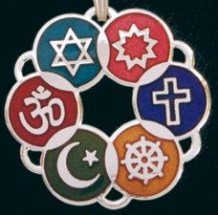 It’s the passage that’s always brought up when Christians get together to talk about interfaith relationships. It is one of THE intrafaith questions. What do we do about “I am the Way, the Truth, and the Life. No one comes to the Father except through me”?
 PLURALISM SUNDAY
 As I was looking at the
  But there are big days coming up for other religions as well. On April 5, Hindus will celebrate
  April 11-18 is Passover, commemorating the liberation of the Israelites from slavery. Jews will also observe
  The twelve day
  For Muslims, April 24 is
  The Interfaith Pastor