I received a Raku pottery “dream jar” last Sunday as a gift from First United in honor of my 11 years of ministry there. The instructions that came with it are to “write down your dearest dreams and place them in the earthen vessel.”
In a very real sense, I already have my dream job. I’ve been able to explore my own questions of theology and Christology among people who also want to explore those questions. Together we have created worship services that reflect our understanding of what it means to be a Christian in a multi-religious world
For the anniversary celebration on Sunday (which included recognition for our music director of 21 years, Orion Pitts), the congregation wanted to have a special worship service. They specifically wanted to invite all the guest speakers from other religious traditions we’ve had over the past fews years, as well as our members, friends, family and colleagues.
Orion and I assumed that we’d have our usual Sunday service, with the appointed readings for the day, etc., but that at some point someone would get up at some point and say nice things about us. It turned out, though, that the invitation that went out said that it would be an “interfaith service.”
That put me in a quandary. While our regular service is always interfaith-friendly, it’s still very much Christian. So should we redesign the whole thing to be completely interfaith, asking guests to participate in readings and/or rituals from their own traditions? Or should we just do what we normally do and explain that non-Christians were welcome to join in as much as they felt comfortable? And what to do about Holy Communion?
Added to the pressure I felt was the fact that the day would also include the launching of my book, The INTRAfaith Conversation. So with interfaith dignitaries in attendance, my reputation was on the line (or so I thought)! Right here was a case study for the next edition of the boo.
Well, the service turned out beautifully. But it did take some thoughtfulness and intentionality. I decided that the way to go was with an emphasis on interspirituality rather than interfaith. “Interspirituality” is a term coined by the late Wayne Teasdale, who described it as “a religious perspective that draws on the mystical core of the world’s religions.” The heart of interspirituality is the recognition that there are many approaches to the spiritual journey. The key is the prefix “inter.” The essential spiritual interdependence of the religions exists because of the essential oneness of being and reality. All religions are part of the one cosmos in which everything is interrelated. “Inter” implies an openness and eagerness to communicate with people of other faiths, to learn from the wisdom of their traditions, and to assimilate that which is useful for one’s own journey.
The liturgy that Orion had put together was already there, so that was no problem. So the first question was about the readings. The gospel reading for the 5th Sunday of Easter was just perfect: John 13:31-35, which includes the verse from Jesus’ Farewell Discourse, “I give you a new commandment: love one another. And you are to love one another the way I have loved you.”
But I decided to forego the texts from Acts and Revelation. Instead I chose an excerpt about interspirituality from an article by Wayne Teasdale. I divided it into sections and asked some of our interfaith guests to take turns reading. The second reading was a poem, “The Way Back, The Path Forward” from Light Reading: Selected Poems from a Pilgrim Journey by the Rev. Canon Charles P. Gibbs. Charles is an Episcopal priest; until his retirement he was the founding executive director of the United Religions Initiative; and he is now Senior Partner and Poet-in-Residence for the Catalyst for Peace foundation. He’s one of the most interspiritual people I know. His poem was perfect for our occasion. For the psalm of the day we used Opening to You: Zen-Inspired Translations of the Psalms by Norman Fischer.
The next dilemma was Communion. I had no problem including Communion, as long as we were able to articulate that we believed it to be an all-inclusive ritual that is bigger than Christianity. So I wrote an article in our newsletter to make that clear ahead of time. And I also made an announcement to that effect both at the beginning of the service and at the invitation to receive the bread and wine. Of course, everyone was free to partake of anything in the service to the extent they felt comfortable.
So it all turned out great. But it’s definitely a study in interfaith and intrafaith awareness, sensitivity, and action. You may or may not agree with all of our decisions, but I hope this will get your creative juices flowing about how you would go about planning interfaith worship in a Christian church.
 It’s gratifying to see that intrafaith is finally becoming part of the interfaith scene. Another new book has taken on the question of how we “live and witness as Christians in a multi-religious world” (Presiding Bishop Emeritus Mark Hanson on the back cover).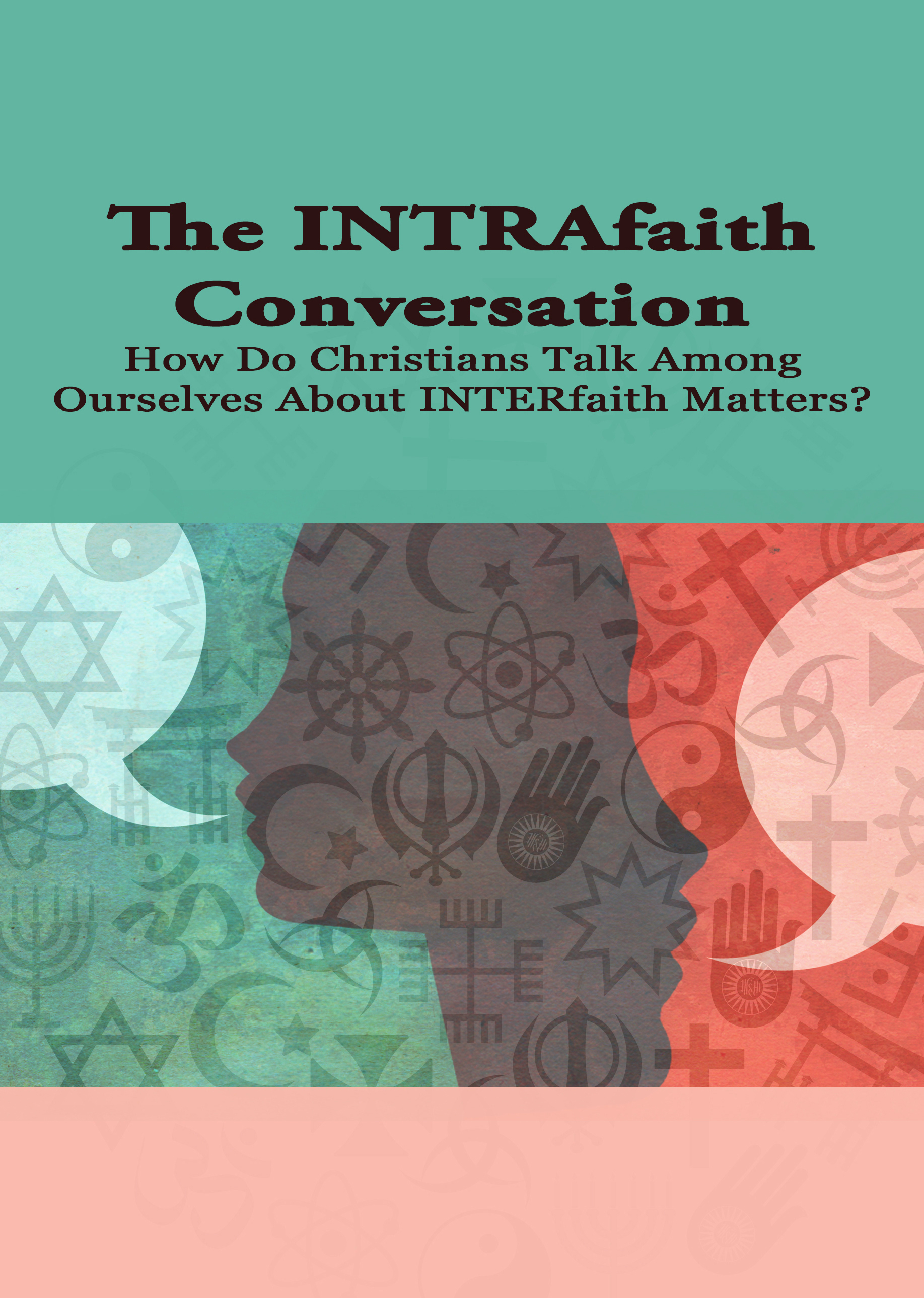
 Tolerance … usually has an elitist lining; either an elitist lining in the sense that you can be tolerant because for you it is not that important, or an elitist lining of noblesse oblige ‑ I know, but I cannot expect the other to know as much as I do. – Krister Stendahl.
 bumper sticker, with “Tolerance” spelled out with symbols of the world’s religions, and know that it’s meant to be an inclusive sentiment. When Swami Vivekananda addressed the World Congress of Religions in Chicago in 1893, he spoke of “a religion which will have no place for persecution or intolerance in its polity.” Since the Congress was the first formal gathering of representatives from both Eastern and Western traditions, it is easy to understand why he paired persecution and intolerance in his speech. Tolerance was then a great improvement over prejudicial beliefs and actions.
 It’s almost here. This is just the draft cover. We have one more proof-reading to do. And then – book launch!
 Those of us who are still in the church must accept the fact that for many people the old categories of Catholic/ Protestant, Episcopal/ Methodist, high church/ low church, contemporary/ traditional, etc. just do not matter. There are new voices contributing to the religious scene, although most of them would not like to be referred to as religious. These voices deserve to be heard. They may have left or never been part of the church, but that doesn’t mean that they don’t have a lot to say about spirituality, the meaning of life and how to make a difference in the world.
 About every five hundred years the Church feels compelled to hold a giant rummage sale. -Bishop Mark Dyer
  The Interfaith Pastor