Subscribe to my Youtube channel at http://www.youtube.com/@revdrsusan.
Category: diversity
-
Pluralism 101
Subscribe to my Youtube channel at http://www.youtube.com/@revdrsusan.
-
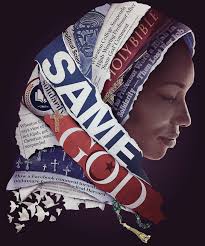
Same God Is Out! Go See It!
 “Same God” – Embodied Solidarity Comes at a Price
Back in 2016, I wrote two posts about Professor Larycia Hawkins, who was removed from her tenured position at Wheaton College because of her “embodied solidarity” with Muslims.
Wheaton College: an Intra-faith Controversy
The Professor Wore a Hijab in Solidarity – Then Lost Her Job:
An INTRAfaith Case StudyThen in 2018, I learned that there was a documentary about this intriguing story. So, of course, I wrote about that: Do Muslims and Christians Worship the Same God: More from Wheaton College
Now, it’s here! “Same God” is being shown this month on some PBS stations. Watch the trailer and find local listings here. There will also be a limited theatrical release beginning March 8. The best way to get information is to follow @samegodfilm on FB, Twitter, and Instagram.
“Same God” was directed by Emmy-winning documentary filmmaker Linda Midgett, who is herself a graduate of Wheaton. But make no mistake about it; this is not a defense of the institution. Nor is it a condemnation. It is a beautifully filmed, honest telling, not only of Dr. Hawkins’ story, but also of the history and current state and challenges of evangelical Christianity.
A Quick Recap
It really all started in 2013, when Dr. Hawkins (or Doc Hawk as students call her in the film) became the first female African-American tenured professor at Wheaton. At Wheaton, an explicitly Christian liberal arts college, all faculty members are required to annually sign a covenant which defines what it means to be “dedicated to the service of Christ and His Kingdom.” As the film tells us, Dr. Hawkins willingly and faithfully signed this covenant upon her employment and every year thereafter.
Then, on December 2, 2015, 14 people were killed in a terror attack in San Bernardino. Immediately, anti-Muslim rhetoric in the US began to ramp up. Then-candidate Donald Trump called for a Muslim travel ban. In response to this, Dr. Hawkins posted on her Facebook page that she was standing in solidarity with Muslims because they are also “people of the book” who worship “the same God.” As part of her Advent devotions, she posted a picture of herself wearing a hijab. That’s when it hit the fan. Long story short: she lost her job. The film covers all this very well, with interviews of Hawkins, plus faculty members and students. No one from the administration agreed to be interviewed.
 A Rorschach Test
There is so much in this film that could and should spark dialogue. Someone said that the picture of Dr. Hawkins wearing a hijab was like a Rorschach test; different people would see different things. For example, many Muslim women would see an act of compassionate solidarity (what Hawkins would call embodied solidarity). For others, it would surface questions about academic freedom, religious liberty, and theology. I would add that having seen the film, the picture is a stark symbol of the systems of patriarchy and white privilege at work. It’s also a reminder of the need for interfaith dialogue. The ignorance expressed in many of the reactions to Dr. Hawkins’ post is simply appalling.What I see in the inkblot is an intrafaith conversation needing to happen.
To be sure, there are many facets to this story: blatant racism and sexism; the emotional toll of the entire saga on Dr. Hawkins; and not to be ignored, the career and financial hits she was forced to take. All of these are very worthy of our attention. But what caught my intrafaith eye was the hurt she experienced in being accused of not being Christian. In a review in the Chicago Tribune, Linda Midgett expressed hope that her documentary will spark dialogue between people of different faiths so they can find common ground. I wholeheartedly agree! But I also hope it will encourage dialogue between people within the same faith – in this case Christianity.It Really Is about Theology . . .
In the film, Dr. Hawkins says that the controversy in which she was embroiled was not about a theological debate. In the context of her grilling by the Wheaton provost, I agree and applaud her courage in naming what was unfair in the process and her refusal to engage in further “theological conversation.”Having said that, it is clear that theological questions loom large over the whole saga. Dr. George Kalantziz, Professor of Theology, hits the nail on the head: “When we ask the question ‘does Islam (or any other religion than Christianity) worship the same God?’ it’s always a qualified ‘yes’ and ‘no.’ We don’t all understand the word, not only ‘God,’ the same way, but worship the same way.”
Bingo! Wheaton missed an opportunity to explore these questions.
And Even More So, Christology . . .

I’m particularly interested in the Christological questions raised by the firestorm of responses to Dr. Hawkins’ assertion that Muslims and Christians worship the same God. In the film, as Dr. Kalantziz is speaking, the camera pans across a beautiful church sanctuary. In the foreground is a gold processional cross. The symbolism is unmistakeable: this is a place that worships Jesus the Christ. Although never explicitly stated in the film, this is the heart of the matter. Who was/is Jesus? How does belief in Christ as the second person of the Trinity inform our beliefs about the truth of other religions?The interview with Bishop David Zac Niringiye would be the perfect discussion starter on how our interfaith encounters inform/strengthen/challenge/change our own beliefs. Speaking eloquently of the need for Christians to listen to our Muslim siblings, he says, “There is something about what they know of God that might cause me to understand God more.” He goes on to qualify: “Now, it is true, that the revelation of God is finally in Jesus Christ. It is complete.”
There is where I’d want the conversation to begin.
“Your Christianity Isn’t Real”
One of the most heartbreaking aspects of Dr. Hawkins’ story is the fact that her identity as a Christian was called into question. I can relate to a point. My job was never on the line. But I know that my adherence to orthodoxy has been questioned. In my case, it’s because I’ve moved further into Progressive Christianity, which has major differences with more traditional ways of believing. The ironic thing here, though, is that Hawkins is quite at home in evangelical Christianity. In the film, she movingly speaks about her baptism in her grandfather’s church, her love for Jesus and how that informs her work in the world. An interesting aspect of the film is its contrasting of African-American and white evangelicals. I was reminded that ‘evangelical’ does not describe a monolithic group; we on the more liberal side should not use the term irresponsibly.I’m part of a denomination with ‘evangelical’ in its name: The Evangelical Lutheran Church in America. We often have discussions about removing the ‘evangelical’ part because we don’t want to be identified with what has become white evangelicalism since the 1970s (this was a really helpful part of the documentary). Listening to Wheaton faculty members, it’s clear they’re having some of the same dilemmas. I believe we could easily find some common ground in an intrafaith dialogue.
Who Are We? Christian Identity in the 21st Century
Most religious groups are undergoing a time of questioning about their place in the world. This is causing great anxiety among many people and institutions. As Dr Kalantziz said, “Questions have moved. People, ideas have moved . . . expressions of theology have changed.” This is not good news to many who are resistant to change, especially in theology and religious practice. He talks about the evangelicalism of the past and the future, about two kinds of leadership: pioneers and overseers. The role of overseers is to keep the heritage of American evangelicalism alive.Wheaton College, despite its pioneering history as a stop on the Underground Railroad, has become an overseer, dedicated to an evangelicalism of the past. Larycia Hawkins, on the other hand, can be seen as helping to usher in an evangelicalism of the future. That’s obviously not an easy place to be. The film poignantly allows us to enter into her life – in the courage, strength, conviction, and resilience, as well as the vulnerability, suffering, and loss. I don’t know how anyone could fail to be moved by her story.
My interest in Dr. Hawkins began as a rather academic exercise in showing an example of an intrafaith issue. Having seen the film, I’m even more of a fan – of the person and her witness of faith in action. It’s still an intrafaith story, but so much more. I hope it will be seen by Christians, from evangelicals to progressives. And I sincerely hope that director Linda Midgett’s vision of her documentary sparking dialogue will be fulfilled: both between people of different faiths and between people within the same faith.
https://www.facebook.com/samegodfilm/
https://twitter.com/samegodfilm/
https://www.instagram.com/explore/tags/samegodfilm/

-
You Might Be a Christian Atheist If . . .
 New Voices . . .
is a chapter in my book, The INTRAfaith Conversation, in which I describe some of the groups now included in the interfaith scene.
These groups include . . .
Atheists and Humanists
Since the book was published in 2015, there have been a lot of new developments. I was aware of the wide range of definitions for atheists and humanists when I wrote the book. Since then, I’ve been fascinated by the further exploration, expansion, and definition of these terms. I’m not much interested in the fundamentalist atheists, who are just as dogmatic as the religionists they criticize. But I am drawn to those who are exploring the boundaries of who and what God (or Being or Presence or no word at all) is.
Probably the most public lately has been Gretta Vosper, the self-professed Atheist who is a pastor in the United Church of Canada (I wrote about her in Should the Atheist Pastor Be Defrocked?). In 1997, four years into her call to West Hill United Church in Scarborough, Ontario, she preached a sermon called “Deconstructing God.” At that point, she defined herself in a more “not this” manner, declaring that she did not believe in a theistic God. Then in 2013, she moved from non-theism to atheism after she read about the plight of Pakistani bloggers who faced punishment as blasphemers for questioning the existence of God. For her (according to her website), “god is a metaphor for goodness and love lived out with compassion and justice, no more and no less.”
In 2017, I met Carrah Quigley when we presented a workshop together at the Parliament of the World’s Religions in Toronto. Carrah identifies as a Spiritual Humanist. According to the Church of Spiritual Humanism, this is a “religion based on the ability of human beings to solve the problems of society using logic and science . . . using scientific inquiry we can define the inspirational, singular spark inherent in all living creatures.” Spiritual Humanism is natural, not supernatural.
 Atheists for Jesus?
Then, just this month I came across the category of Jesus-following Atheists (also known as Christian Atheists) in an article entitled Inter-faith Dialogue with Christian Atheists.
Hmm. Intriguing.
From what I’ve read, it seems that the main focus of Christian Atheism is the life of the historical Jesus and the system of ethics drawn from his teachings. Although, regarding the subject of God, there is some divergence. While some do reject the idea of God altogether, others dismiss the belief in a supernatural, interventionist God. According to the author of What Does It Mean to Be a Christian Atheist?, “I still believe in ‘God.’ What I do not accept is belief in a theistic deity, a ‘being’ that created the universe, holds the universe together, or exists in or apart from the universe.”
Of course, Bishop John Shelby Spong has written and spoken much about the death of theism, and I greatly appreciate his insights about coming to reject the belief in a supernatural power. I don’t think he calls himself an a-theist; he’s more inclined to dismiss as inadequate these words for our experiences of the Divine. The experience is what is important. In this sense, I have no qualms about calling myself an a-theist. Especially since he doesn’t reject the reality of mystical experiences of the Holy, as do some who adhere only to the ethical teachings of Jesus.

However, at the end of the day, I still resonate most with Teilhard de Chardin’s panentheism, in which all creation exists within a ‘divine milieu.’
Still, I am intrigued by the ongoing exploration of what we mean when we think about God (the Divine, Spirit, or no name at all). The freedom to go outside the bounds of our traditional (and limited) understandings enhances not only our own spiritual/ethical life, but our communal life as well.
The interfaith world benefits from the presence of those who do not fit the definition of “religion.” The intrafaith scene can benefit as well, if we get past our prejudices (especially when we don’t know the broad range of these groups) and listen to their stories.

-
ELCA’s Inter-Religious Commitment
One of the workshops I attended at the Parliament of the World’s Religions (PWR) in November was At the
 Intersection of Ecumenical and Inter-Religious Relations. One of the reasons that session appealed to me (among the 15+ other offerings at the same time) was the moderator of the panel was Kathryn Lohre, executive for Ecumenical and Inter-Religious Relations for my denomination, the Evangelical Lutheran Church in America (ELCA)
She is also one of the members of the task force that created Inter-Religious Commitment: A draft policy statement of the Evangelical Lutheran Church in America. This is a new social statement that will be considered at our national church gathering this coming August.
Here’s the PWR workshop description – and if you’ve read my book or anything else on this blog, you’ll understand why it was right up my alley (bold type is mine):
In the midst of rapid changes in our global religious landscape, Christian churches, denominations, and councils of churches are increasingly exploring what it means to be Christian — and to seek Christian unity — in a multi-religious world. New approaches to interreligious relations are emerging, and focus is being given to understanding complex forms of religious and spiritual identities, practices, and communities. All of this is raising important and timely questions about the challenge of Christian supremacy in interreligious spaces and relationships.
The panel also included Donna Bollinger, executive director of Religions for Peace USA; André Lavergne, Assistant to the Bishop for ecumenical and interfaith matters for the Evangelical Lutheran Church in Canada; Karen Thompson, minister for Ecumenical and Interfaith Relations for the United Church of Christ; and Paul Tché, president of the Council on Christian Unity of the Christian Church (Disciples of Christ) in the US and Canada.So, I thought, here were some heavy-hitters for the mainline churches on the interfaith scene. I wanted to hear about how we Christians were going about navigating all the issues inherent in engaging with our multi-religious milieu. And I wasn’t disappointed. That is, until the Q&A time. One of my gripes about the Parliament is that there’s never enough time to really engage in a topic after a workshop or presentation. The conversation that began after this one could have gone on for hours. Although unfortunately it got sidetracked by a couple of guys, members of non-Christian groups, who thought it necessary to “mansplain” how we Christians could get around our issues. By the time I got to ask my question, our time was almost up.
What I wanted to know was this: how are the interfaith departments in our denominations working with other departments to promote the idea that interfaith – and of course I’ll also emphasize intrafaith – engagement is not simply an add-on to all the other work that goes on in our churches? Understanding our religious diversity – and our response to it – is a necessity for our work in Christian education, evangelism, seminary training, to name a few. Most of the clergy I know are overwhelmed with the day-to-day stuff that leading a congregation entails.
Plus, in the midst of the down-sizing of the Christian church, many congregations are anxiously trying to figure out how to stay open. Interfaith dialogue seems to be a luxury they cannot afford. But my premise is that it is not a luxury. In fact, as the church learns how to be present in the 21st century, albeit smaller, it will have to add interfaith and intrafaith engagement to its toolbox.
So I’m excited about the upcoming presentation of Inter-Religious Commitment: A draft policy statement of the Evangelical Lutheran Church in America at our Churchwide assembly in August. Although I do have some questions, as well as suggestions for implementing the document. But that another post. Stay tuned.
-
Christianity on the Spot
 “Can I put you on the spot?”
That was the question asked by the woman who came up to me after the International Day of Peace brunch at Pacifica Institute.I might have been the only Christian in the room. I’m not sure about that, but of all the people who spoke and identified their tradition, most were either Jewish or Muslim. But I was the one who was there in a clergy collar, was introduced as a reverend, and had stood on the stage to
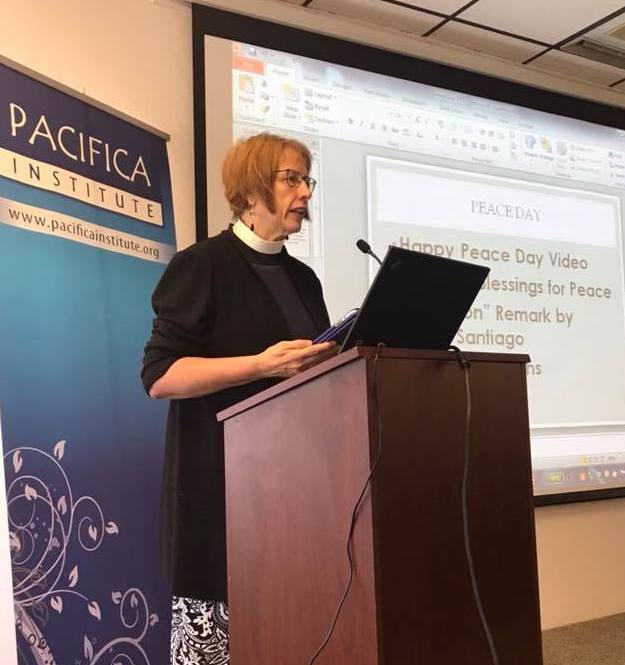 offer a peace blessing after brunch.
 Can I put you on the spot?”
“Of course,” I said, pretty much guessing at what the question would be.
“What do you think about these Christians who are supportive of Trump?”I knew it! Immediately the anger rose up in me – not at my new friend, but at the awful predicament we Christians are in. I explained about the growing divide between us. On one side are some evangelicals who are trying with all their might to hold onto a dying theological worldview which embraces tribalism, exclusivity, individual salvation, and a hierarchical/patriarchal ordering of the world. On the other side are those who are leaning into a new paradigm of interconnectedness, interdependence, interspirituality, and inclusivity.
I also shared my theory that the reactivity we’re witnessing in both religion and politics is due to the fear engendered by this shift. In a way, I can sympathize. Theologian Hans Küng calls what we’re going through a “Macro-Paradigm-Shift,” affecting all of our institutions on a global scale. Some characteristics of the emerging paradigm are:
- It’s global. Humanity is seen as a single tribe and this one tribe is interconnected with the total cosmos.
- It’s an age of dialogue, not monologue. Instead of talking only with those like us, we meet with people of differing convictions, not as opponent, but in order to listen, share and learn from one another.
- It will be characterized by a deep commitment to environmental justice, including a shift from an exclusively anthropocentric view to one which sees humanity in interdependent relationship with all other life forms and with the Earth itself.
- It will involve a redefinition of religion. Many of the answers given in the past do not address questions being asked today. Just as Christianity moved from a Jewish way of thinking into one of Greek philosophy (which produced the ‘substance’ language of the Nicene Creed), we are now moving into a new way of reflecting on theological matters.
I get it; change is difficult. Even when I’m in full agreement with a change in my own life, I still feel discomfort as I go through it. So I get the resistance to change. I can even sympathize with it to a point – but not with the reactionary, knee-jerk attempts to hold back the flow of history.
As a Christian, it is helpful (although sometimes frustrating) to be in an interfaith setting. Seeing myself through the eyes of a Jew, Muslim, Pagan, or Atheist reveals the intrafaith spot we’re in. It’s not enough to vehemently declare, “I’m not like those Christians. We have to define ourselves by who we are.
At another interfaith gathering last week, a Jewish woman spoke up and said that she was usually more comfortable with Muslims because the issue with Jesus never comes up; with Christians, you just couldn’t be sure. Once again, I felt the desire – the urgency – to promote a different kind of Christianity than the kind that turns people off.
The divide is growing and we are on the spot. How will we contribute to peacemaking in our churches, communities, and world – as Christians of a new paradigm?
-
The INTRAfaith Conversation in Islam
“The Shoe Is On the Other Foot: Pluralism and the Qur’an” is a terrific article by Professor Jane Smith from Harvard Divinity School. She raises the question of whether or not Islam itself can find a way to live out the pluralism that many are persuaded is at the heart of the Qur’an’s message. She writes:
It seems to me that the future of Islam, at least as I understand it in the American context, has much to do with the way that Muslims figure out how they are going to position themselves on the question of pluralism. That we all live in a religiously differentiated society is a given. But is that a good thing in the Muslim perspective? While Muslims struggle to be truly accepted by Christians, Jews, and other groups in America, can they promise the same in return? And if so, at what level?
This is the crux of the intrafaith conversation within Islam. Mostly the same kind of questions as within Christianity. The content of the issues is different but the process is essentially the same.
You can read the whole article here.
-
Bring All People to Faith in Christ?– Maybe Not
 Today’s intrafaith question:
What about the Great Commission?In Chapter 9 of my book, I wrote: If we do not reject the truth claims of other traditions, we may have some problems with our own. These dilemmas are not solely academic exercises. They are very practical issues that need to be addressed, for example, in our practices of evangelism and mission. As Asian theologian C. S. Song has written: “The problem of Christian mission is is the problem of Christian theology. Reconstruction of Christian theology must then precede reconstruction of Christian mission.”
So it was with great interest that I read of the resolution passed by the New England Synod of the Evangelical Lutheran Church in America (ELCA) at its annual assembly in June. You can read the full resolution here, but the bottom line is this:
Whereas in the light of the growing positive and rich multi-faith engagement of the 21st century, we have come to a new humility about the question of God’s relation to other religions: Be it resolved that the New England Synod memorialize the ELCA Churchwide Assembly to initiate a process to amend the phrase “bring all people to faith in Christ” in C4.02b and its constitutional parallels in order to achieve greater consonance with both our understanding of Christian witness and sensitivity to our interfaith contexts.
I actually learned about this resolution from a blogger who is adamantly opposed to any such change which would “soft-pedal our faith” and move us further “out of historic and traditional Christian heritage and closer toward cultivating a rampant religious universalism.”
As much as I agree with and applaud the resolution and distain the language of demonic apostasy in the blog, I certainly recognize the intrafaith challenge presented here. What do we do with the mandate presented in Matthew’s Jesus to “go and make disciples of all nations”? What is Christian mission anyway?
I also applaud the second part of the resolution:
Be it further resolved that the resources of the ELCA enlist and consult its teaching theologians, Bishops, and other leaders in the drafting of such an amendment for consideration at its subsequent CWA.We need input from theologians who will take seriously our understanding of mission in the midst of our religious diversity. I am sure there are members of our congregations who fall all along the continuum of belief about Christian mission: from the position of the resolution to the orthodox blogger. I’m also sure that many would welcome serious theological guidance from the church in answer to their questions about faith in the 21st century.
How about you? What do you think the Great Commission means today?
-
Another Take on “I am the Way, the Truth, and the Life”
This is a re-blog of a sermon from Pastor Dawn Hutchings of Holy Cross Lutheran Church near Toronto. It’s entitled “Letting Go of the Words Attributed to Jesus So that We Can Embrace the WORD – Easter 5A – John 14:1-14”
For me, the best part of the sermon is her story of being paired with a Hindu student for an assignment in a Religious Studies program. They were each asked to bring a piece of sacred scripture from their partner’s faith tradition that they found intriguing. To her chagrin, her Hindu friend brought “I am the way, and the truth, and the life. No one comes to the Father except though me” to the table. And to her surprise, he then launched into – as she says – “an exegesis of the text that put this particular Christian to shame.”
Read the rest of the story here.
-
Your INTRAfaith Opportunity: Easter 5
 It’s the passage that’s always brought up when Christians get together to talk about interfaith relationships. It is one of THE intrafaith questions. What do we do about “I am the Way, the Truth, and the Life. No one comes to the Father except through me”?
How do you answer that question? I was interviewed by the Rev. Steve Kindle for Pastor2Pew about this text. You can see that interview here. Let me know what you think.
 The Interfaith Pastor