 I returned to the Jersey shore this summer. I hadn’t been there since 2001. In fact, I was in Ocean City on 9/11/2001. As I watched the towers fall on TV, I could see fighter planes and helicopters flying up the coast. It’s not something you forget. Of course, others have more horrific and tragic stories to tell. But for those of us who were old enough to be aware of what was happening at the time, we’ll always remember where we were on that day. And we should remember: those who died, their families, the first responders, the ongoing after-effects of trauma.
But we should also remember other stories. In Ocean City – and I’m sure in many other
places as well – there was a run on American flags. A friend who was staying with me that week was determined to get a flag to hang off our balcony. I was conflicted about it. I didn’t want to hang a flag off my balcony; I’m not a big fan of flags in the first place. So I was quietly thrilled that every store was sold out.
I also remember overhearing conversations that included words like “rag-heads” and “towel-heads” and references to the Qur’an that were either completely false or taken out of context. The first hate crime reported as a result of 9/11 didn’t happen until the 15th, but the seeds were being sown.
I was due back in the pulpit on September 16. Obviously, I’d have to talk about 9/11. I decided to try to make the service a combination of remembrance, lamentation, and confession. The remembrance and lamentation parts were fairly easy to do, and there were lots of resources being sent out for use that Sunday.
But I was determined not to let us off the hook for our part in the rise of global terrorism. Simplistic answers to “Why do they hate us?” make my blood boil. “Because they hate our freedoms” isn’t an informed answer. We Americans are famous for our ignorance about history, geography, and geopolitical affairs. It takes only a scratch of the surface to find reasons for resentment of American arrogance throughout the world. Even our remembrances of 9/11 will usually neglect to mention the acts of violence and terrorism experienced by people of other countries each and every day.
Do I condone terrorism? Absolutely not. Do I understand it. Definitely yes.
So on that Sunday I tried to gently insert some reminders of our own American culpability. I don’t know how well I pulled it off. I do know that at the end of the service, one member asked if we could sing “God Bless America.” I didn’t handle it well. Following Nancy Reagan’s advice I “just said no.” Looking back, it would have been an opportunity to suggest singing “Finlandia” (“This Is My Song”). Here it is, sung by Joan Baez.
This is my song, O God of all the nations, 
A song of peace for lands afar and mine.
This is my home, the country where my heart is,
Here are my hopes, my dreams, my holy shrine.
But other hearts in other lands are beating,
With hopes and dreams as true and high as mine.
My country’s skies are bluer than the ocean,
And sunlight beams on clover leaf and pine.
But other lands have sunlight too, and clover,
And skies are everywhere as blue as mine.
O hear my song, thou God of all the nations,
A song of peace for their land and for mine.
So what will we do this Sunday? Will we have only remembrances and memorials? Or will we acknowledge the ongoing interfaith and intrafaith work we still have to do in knowing and understanding ourselves and our neighbors?
 No, our Pluralism Summer speaker this week is not Martin Luther! But as a Lutheran pastor, I would be remiss in neglecting the contribution of Luther to the subject of religion and politics. While his
  Having heard from other traditions on the subject of the intersection of religion and politics, it is certainly appropriate to hear from someone working in both realms. In fact, it is an intrafaith conversation, since we’ve heard from other Christian traditions, such as Mennonites and Quakers. There are differences.
 I’m happy to announce a return visit from Elaine Donlin of the
  Next up in our summer of “religion and politics” is Laura Magnani from the Quaker tradition. Laura is director of the American Friends Service Committee’s Bay Area Healing Justice Program in California and has worked on criminal justice issues for over 35 years. She wrote


 I’m particularly happy to welcome two guest speakers this coming Sunday. Ed Driscoll and Jim Lichti are members of
 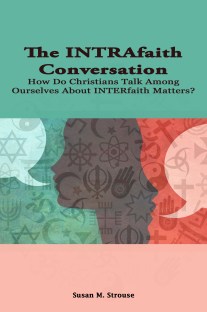 nevitably, profound questions arise out of respectful encounters with people of religions other than our own. Many who have been involved in cooperative engagements with people of other faith traditions discover that it is often easier to talk with people of a different religion than it is with the person sitting next to you in your own congregation. For others, the struggle is within, as in the case of Elsie L., a parishioner in Buffalo. After a church session in which a Hindu woman active in interfaith activities had spoken to the group, Elsie spoke to Pastor Strouse. “If I accept the Hindu path as equal to Christianity,” she said, “I’m worried that I’m betraying Jesus.”
 a colleague called me to ask if I knew a place where the author of a new book on interreligious spirituality might present a talk on this topic. Intrigued, I agreed to a virtual introduction and then went on to set up an in-person meeting.
 There’s a conversation in the movie Nick & Norah’s Infinite Playlist, that’s pretty profound for a romantic comedy.
 This Sunday, our guest speaker will be Rita Semel, who I often describe as the godmother of the San Francisco interfaith community. Don’t mistake her diminutive size or her age for lack of energy or passion for healing the world. Rita’s raison d’etre, which she received from her Jewish heritage, is tikkun olam (literally “world repair”).
 The Interfaith Pastor