Category: Christianity

  • Help Me Create a Christian Float for an INTRAfaith Parade

    macy_s_thanksgiving_marching_band_-_vertOur diverse religious environment can be disconcerting for many people. Author Kenneth J. Gergen once described the disorienting effects of pluralism as that of a “relentless parade.”

    But another author, Theodore Brelsford turns the negative-sounding observation into an opportunity for imagination and creativity:

    It occurs to me that one way to respond to a parade which seems relentless is to build a float and join in.

    So OK, let’s do it! Let’s say we’re building our float. In the festive context of the celebration of diversity, what should our Christian float look like? What symbolic images might we in63c6ac4ee1a4cedb05b14099ed8a44fcclude, and what is it that those symbols symbolize?”

    I tried this out at my workshop at the Parliament of the World’s Religions last October. After an hour of telling stories and surfacing issues and questions, we began putting symbols for our float up on newsprint. It was a lively, fun exercise. Not everyone agreed on each symbol – not even a cross. Someone wondered if we might have to have more than one float. Unfortunately, time ran out. These conversations do take time. But I discovered that Brelsford’s metaphorical float idea is a good one.

    rmt16773So what’s your symbol? Let me know what image conveys to you the heart of the Christian message. Maybe it’s a traditional church-y one. Or maybe it’s something no one would ever expect to see in a  stained glass window.

    Attach a picture if you have one – and a little explanation of why this symbol is meaningful to you. If I get enough, maybe I can create an intrafaith parade right here on this blog!

    To get us started, here’s one of my favorites. One of the gospel of John’s “I am” sayings, has Jesus s2492729_origaying “I am the vine; you are the branches.” Of course, in these “I am” passages, John wants to connect Jesus to the great “I AM” of Exodus.

    I don’t want to get into christological matters right now (happy to at other times, though!); I don’t have to believe in the formulations of the Nicene Creed  in order to appreciate the metaphor. What I see in the vine imagery is that we are all connected to the Source of Life – and we are all interconnected with one another.  So a vine goes onto the float.

    Now – what say you?


    Gergen, Kenneth J., The Saturated Self: Dilemmas of Identity in Contemporary Life (NY: Basic Books, 1991), quoted in Theodore Brelsford, “Christological Tensions in a Pluralistic Environment: Managing the Challenges of Fostering and Sustaining Both Identity and Openness,” Religious Education, (Spring 1995): 176.

    Brelsford, Theodor, “Christological Tensions in a Pluralistic Environment: Managing the Challenges of Fostering and Sustaining Both Identity and Openness.” Religious Education, 90, no2 (Spring 1995): 174-189, 188.


  • Not That Kind of Christian!

    backto3It’s a tough time to be a Christian. More and more, we’re being forced to choose what kind of Christianity we shall be identified with. Evangelical, fundamentalist, progressive, traditional, conservative, liberal: the labels aren’t that simple.

    In this presidential election campaign, a rift has split evangelical Christians. The candidacy of Donald Trump has required many evangelicals to do theological gymnastics to defend their candidate. Even after the release of the video which graphically revealed Trump’s ugly, misogynistic character, his defenders stood fast. Robert Jeffress, pastor of First Baptist Church in Dallas and a member of Trump’s Faith Advisory Council, said Trump is “still the best candidate to reverse the downward spiral this nation is irotaten.”

    But other evangelicals disagree. In a letter published on September 28 (so even before the video was made public), about 100 evangelical Christian leaders, including Rachel Held Evans and Jim Wallis, condemned Trump’s candidacy. Some snippets from “A Declaration by American Evangelicals Concerning Donald Trump:
    Wallis and AOS book, 2.jpgWe believe that racism strikes at the heart of the gospel; we believe that racial justice and reconciliation is at the core of the message of Jesus.
    We believe the candidacy of Donald J. Trump has given voice to a movement that affirms racist elements in white culture – both explicit and implicit.
    We . . . simply will not tolerate the racial, religious, and gender bigotry that Donald Trump has consistently and deliberately fueled.

    Although I don’t agree with all of the theology expressed in the letter, what I like about it (besides its condemnation of Trump) is its unapologetic Christian witness. They clearly do make the disclaimer of “not that kind of Christian”:
    A significant mistake in American politics is the media’s continued identification of “evangelical” with mostly white, politically conservative, older men. We are not those evangelicals. The media’s narrow labels of our community perpetuate stereotypes, ignore our diversity, and fail to accurately represent views expressed by the full body of evangelical Christians.

    But they also clearly say what kind of Christians they are. We progressives often fail to do that. We’re very good at saying “not that kind of Christian!” but not always so good about putting our beliefs out there. So in the interest of putting my money where my mouth is, here’s my declaration:

    As a progressive Christian, I am a follower of Rabbi Jesus, who consistently taught that the realm of God is near, within us and around us. My role as a citizen of my community, country, and world is defined by the example of Jesus, which includes boundary-crossing, inclusivity, and prophetic witness in the face of oppression. It is also defined by the teachings of Jesus, which include compassion, forgiveness, and concern for the “least of these.”

    I also believe in the mystical body of Christ, which I do not see as limited to Christianity. One might call this the Cosmic Christ, the Tao, the Universe, or Buddha Nature. In this body, in which all things are interconnected, there is no separation between divinity and humanity, humanity and the rest of creation, male and female, body and spirit, etc., etc. My connection to this great web of life is what gives me the inspiration and ability to follow the teachings of Jesus.

    Therefore, as a progressive Christian, I cannot condone the misogynistic behaviors, the racist rhetoric, or unethical business practices of Donald Trump. I just can’t imagine what Jesus those evangelicals who continue to make excuses for him follow.

    I am unapologetically (not arrogantly, exclusivistically, or obnoxiously) Christian – just  not that kind. 13722038_975213099262133_1521863844_n


  • INTRAfaith Relationship: It’s Complicated


    its-complicatedOne of the options on Facebook for announcing your relationship status is “it’s complicated.” And for some people, entering into interfaith relationships can be complicated, if not downright threatening. Then add in the need for intrafaith conversation  and things can get really challenging. For this reason, I love this poem/prayer by C.S. Song.unknown-2

    Choan-Seng Song is a Distinguished Professor Emeritus of Theology and Asian Cultures at the Pacific School of Religion in Berkeley. I had the privilege of being part of a theological discussion group during my doctoral studies there. Professor Song opened my eyes to other ways of looking at Christianity, specifically through an Asian lens. Once I realized how thoroughly western my theology and Christology was, a new way into interfaith thology opened up before me.

    51matoyngwl-_sx331_bo1204203200_But Dr. Song is not just an academic. He’s also a pastor. And, in my opinion, nothing expresses this more than this poem/prayer, which was published in the PSR newsletter. I’ve used it innumerable times in workshops as a way to reassure people just entering into interfaith and intrafaith relationships that discomfort is to be expected, in fact it’s perfectly normal.

    A PRAYER: It Is Difficult, O God

    It is difficult, O God
    it was much easier before
    we lived in our own world
    we took that world for the entire world
    we believed we were your chosen people
    with special privileges and advantages
    we thought we had nothing to learn
    from people who were different from us
    in what they believed and how they lived
    but suddenly all these people are all over the place
    they come to live in our midst
    they speak all sorts of languages
    they practice different faiths
    they even dress differently.

    It is complicated, O God
    it was much simpler in the past
    we lived among like-minded people
    we used to understand each other
    we ate the same food
    we shared the common thoughts
    we even acquired the same habits
    we seldom ventured out of our compound
    we were contented with what we knew
    but all of a sudden the walls that separated us from other people crumbled
    we have lost control of our life
    we are afraid we are no longer master of our own destiny.

    But it has never been easy for you, O God
    it has never been simple for You
    You have always dealt with a world of wonderful plurality
    with many people and many nations
    with many cultures and religions
    with women as well as men
    with children as well as men and women.

    But instead of complaining, You enjoy it
    instead of becoming upset, You delight in it.
    Though it is still difficult for us
    help us, O God, to enjoy it with all its multiplicity
    though it is still too complicated for us
    enable us, O God, to cope with it
    with the spirit of gratitude and wonder
    and inspire us to know ever more deeply
    the mystery that is Yours
    the truth You alone can disclose to us.


  • Should the Atheist Pastor Be Defrocked?


    2393916804_765925fe9d_bWhen I told the people of Northern Ireland that I was an atheist, a woman in the audience stood up and said, ‘Yes, but is it the God of the Catholics or the God of the Protestants in whom you don’t believe?’ – Quentin Crisp
    Tell me about the God you don’t believe in – Marcus Borg


    Atheism is a tricky business – especially these days. It used to be simple: an atheist was someone who didn’t believe in God. Then many of us read or heard Marcus Borg describe his many conversations with university students. He recounts, “Every term, one or more of them says to me after class,‘This is all very interesting, but I have a problem every time you use the word ‘God’ because, you see’ – here there’s usually a pause and a deep breath – ‘I really don’t believe in God.’ I always respond the same way: ‘Tell me about the God you don’t believe in.’”*

    As Borg tells it, the student then describes a version of God that he or she perhaps learned in Sunday school, from his or her parents or simply from popular culture. When Borg says, “ Well, I don’t believe in that God either,” a space opens up for conversation about other possible ways of understanding the Divine.
    The United Church of Canada had an opportunity to enter such a space for conversation. WKxYuGGyLast week a review committee that found Gretta Vosper, pastor of West Hill United Church in Toronto “not suitable” to continue in her pastoral role because she doesn’t believe in God. Now she faces a formal hearing to determine whether or not she should be defrocked.
    A petition circulating in support of Rev. Vosper concludes:
    “Persuaded that the theological conversation Gretta Vosper has provoked is a matter for dialogue and not a matter for discipline; we, the undersigned, urge the sub-Executive of Toronto Conference to reject the recommendations of the report of the Conference Interview Committee.”But what does Gretta Vosper believe? It might be easier to begin with what she does not believe: “I do not believe in a theistic, supernatural being called God.”
    At her ordination in 1993, when asked if she believed in God, Father, Son and Holy Spirit. She said yes, speaking metaphorically. Eight years later, she began to deconstruct the idea of God. She said, “Our hymns and our prayers and the way that we did things, they all reinforced this idea of a supernatural divine being who intervened in human affairs. I just took it apart – I was not willing to continue to let (my congregation) think that I believed in that kind of God.” The worship service now uses more metaphorical interpretation of religious symbols and places emphasis a strong emphasis on environmental and social justice.
    She’s been controversial, to be sure. The congregation has undergone a severe decline in membership. However, those who’ve stayed are steadfast. One member has said, “West Hill is the future of what religion will be like. We’re thinking and saying what the rest of the world is scared to, but moving towards.”
    So is Vosper a church-wrecking heretic? Or a prophet, pushing to bring the “God” conversation into the church – a role she describes as “irritating the church into the 21st century”
     As more people discover that there are other ways of thinking about their concept of God, the old definition of “not believing” becomes more problematic. Agree with Vosper or not, she is bringing to the fore a conversation that needs to happen. Heresy trials aren’t the way to go.


    *Borg, Marcus, The Heart of Christianity: Rediscovering a Life of Faith. New York: HarperCollins, 2003, 68-69.

  • The Reviews Are in!

    she likes it

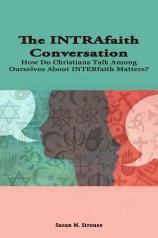
    I am happy to report that, so far, The INTRAfaith Conversation has a 5-star rating on Amazon. Below are the five reviews (in reverse chronological order) that have been submitted. And yes, I would love more! If you’ve read the book, please let me know what you think. After all, it’s supposed to be a conversation.


    5.0 out of 5 stars
     
    Giving Peace a Chance
    By June on September 16, 2016

    This is an important book for our times. It will be essential reading for all people of faith and those in our country who experience spirituality outside the faiths. Strouse explores what it means for Christians to dialogue together with the beliefs of other world religions, with other denominations and within one’s church. This book ushers us step by step into a process towards unity of love and respect that enables us to discover how to live the love in which we believe as well as to evolve from a rote worshipper to a discerning believer. She shows how Christians can accept and respect beliefs of others, find common ground and evolve in our own faith expression to prevent exclusionary or irrelevant evangelism.  It reads fluidly, is serious yet entertaining, logical in light of the history presented, compassionate, educational and inspiring. Strouse has addressed something so timely, necessary (in light of world terrorism), and helpful in understanding what is happening in our declining mainline churches. For the future of the Gospel and the survival of the world, this should be read in our churches for breathing life into our faith, in homes for raising generations of tolerant and inclusive people, and in seminaries as required reading to prepare pastors for encounters / interactions of cultures they will face in their neighborhoods as well as to assist them in utilizing the processes presented.  Whereas missionary work historically meant traveling to convert indigenous peoples, in America today we live amongst a multitude of spiritual / religious faiths which is now our fertile field for outreach, not necessarily for conversion but for establishing and nurturing peace. If this is a time in our world for the church to evolve, let us start with ourselves, those in our faith and others of all faiths to develop and share understandings. The world awaits a revolution of joy and open hearts.

    From The Rev. Barbara Peronteau, M.Div.
    Interfaith Chaplain Resident   August 28, 2016

    5.0 out of 5 starsas Christians can better understand our own faith
    This book was written so that in this pluralistic world in which we now live, we, as Christians can better understand our own faith, and the issues involved with interfaith dialogue, so that we might be more comfortable being in conversation with our neighbors who are not Christian. While this book was written to the larger interfaith dialogue within the broader culture, I find the insights in this book to be very applicable in the clinical pastoral care setting in which I minister. I hope the saying is true that we are judged by the company we keep so by keeping company with this book I might be somewhat smarter than before I read this book. I thoroughly enjoyed reading “The INTRAfaith Conversation”. Susan’s writing style is engaging, easy, and conversational, yet theologically intelligent.

    5.0 out of 5 starsFive Stars bRussell H. Miller  June 22, 2016
    Expertly laid out providing a roadmap for a much needed dialogue.

    5.0 out of 5 starsCrisp and cogent treatment . . . bRichard G. Eddy  June 29, 2016
    This crisp and cogent book by the Rev. Dr. Strouse is published at a time when both interfaith and intrafaith dialogue are critical to the vitality of spiritual life in our nation. As a parish pastor in a small, struggling congregation I have become increasingly aware of the insularity and isolation of many of our parishioners. This seems less the result of inadequate parish education as it is the byproduct of too many people getting their information from biased TV networks, so-called social media or word-of-mouth. We parish pastors need to examine our internal (intra-congregational) conversations about diverse faith traditions and how they bear on congregational mission. I was particularly impressed by the author’s use of footnotes and her extensive bibliography. The book is a “walking-talking workshop” in print with its detailed reflection/discussion questions and suggestions for further reading. Thank you, Pastor Strouse, for such a comprehensive presentation of how to approach constructively this timely and important conversation.

    Inevitably, profound questions arise out of respectful encounters with people of religions other than our own. Many who have been involved in cooperative engagements with people of other faith traditions discover that it is often easier to talk with people of a different religion than it is with the person sitting next to you in your own congregation. For others, the struggle is within, as in the case of Elsie L., a parishioner in Buffalo. After a church session in which a Hindu woman active in interfaith activities had spoken to the group, Elsie spoke to Pastor Strouse. “If I accept the Hindu path as equal to Christianity,” she said, “I’m worried that I’m betraying Jesus.”

    Years of wrestling with that question and similar ones resulted in Strouse’s new book, The INTRAfaith Conversation: How Do Christians Talk Among Ourselves about INTERfaith Matters? In it, Dr. Strouse addresses the challenges that the increasingly interfaith realities of today present to Christians, and invites reflection on how Christian theology and identity might be shaped and even strengthened by cooperative interfaith relationships.

    Blending personal stories, thoughtful reflection on the changing face of America and pastoral concern, The INTRAfaith Conversation invites readers to understand and appreciate just what doing Christian theology means in today’s multi-religious world. The book’s sections reflect the breadth of Strouse’s focus: dealing with the new religious context; what it means to think theologically as a comunity; tolerance, exclusivism, inclusivism, and pluralism; personal experience; and pastoral and leadership issues for congregations entering the interfaith world.

    The book is designed to be used with a discussion group; each section is followed by a series of questions for reflection and discussion along with suggestions for further reading.
    I personally have been involved in interfaith work in the Bay Area for over 35 years and have never seen a book quite like The INTRAfaith Conversation. It addresses a very real issue with depth, humor, and pastoral sensitivity. I highly recommend it not only to pastors and other leaders in Christian churches, but to lay people who may be asking some of the same questions. Further, although it is specifically aimed at a Christian audience, it offers a model for how similar questions might be raised and wrestled with in non-Christian contexts as well.
  • “Talking with Strangers in Sacred Space”

    There’s a really important article in this month’s issue of The Interfaith Observer. Lynda Trono, program convenor on the board of directors for the North American Interfaith Network (NAIN), has written a reflection on the first day of this summer’s NAIN Connect in Guadalajara. She begins by expressing the same feelings I had when listening to the opening keynote by Raul Vera López, bishop of the Diocese of Saltillo. And she ends up with an admission of arriving at the first ever NAIN Connect in Mexico with cultural blinders firmly in place.

    I resonated completely with her frustration at having to listen to a very long Christian sermon at the start of an interfaith gathering. I also shared her chagrin at coming to learn that the bishop, a staunch defender of human rights, is beloved in Mexico – in fact is called the Oscar Romero of Mexico.

    There’s a lesson here for us to learn. As open and accepting we profess to be, we still come into interfaith gatherings with cultural biases and expectations. In Guadalajara I was already aware of (and embarrassed by) my “ugly American” lack of ability to speak Spanish. Now I learn how much deeper my sense of privilege runs. And even as I wonder what might have helped us to bridge the cultural divide earlier than we did, I know that it’s up to me to learn about the culture I’m visiting.

    I’m very grateful for Lynda Trono’s honest and reflective article.


  • 9/11 and the INTRAfaith Conversation

    img_1470I returned to the Jersey shore this summer. I hadn’t been there since 2001. In fact, I was in Ocean City on 9/11/2001. As I watched the towers fall on TV, I could see fighter planes and helicopters flying up the coast. It’s not something you forget. Of course, others have more horrific and tragic stories to tell. But for those of us who were old enough to be aware of what was happening at the time, we’ll always remember where we were on that day. And we should remember: those who died, their families, the first responders, the ongoing after-effects of trauma.alg-flag-jpg

    But we should also remember other stories. In Ocean City – and I’m sure in many other
    places as well – there was a run on American flags. A friend who was staying with me that week was determined to get a flag to hang off our balcony. I was conflicted about it. I didn’t want to hang a flag off my balcony; I’m not a big fan of flags in the first place. So I was quietly thrilled that every store was sold out.

    I also remember overhearing conversations that included words like “rag-heads” and “towel-heads” and references to the Qur’an that were either completely false or taken out of context. The first hate crime reported as a result of 9/11 didn’t happen until the 15th, but the seeds were being sown.

    I was due back in the pulpit on September 16. Obviously, I’d have to talk about 9/11. I decided to try to make the service a combination of remembrance, lamentation, and confession. The remembrance and lamentation parts were fairly easy to do, and there were lots of resources being sent out for use that Sunday.

    But I was determined not to let us off the hook for our part in the rise of global terrorism. Simplistic answers to “Why do they hate us?” make my blood boil. “Because they hate our freedoms” isn’t an informed answer. We Americans are famous for our ignorance about history, geography, and geopolitical affairs. It takes only a scratch of the surface to find reasons for resentment of American arrogance throughout the world. Even our remembrances of 9/11 will usually neglect to mention the acts of violence and terrorism experienced by people of other countries each and every day.

    Do I condone terrorism? Absolutely not. Do I understand it. Definitely yes.

    So on that Sunday I tried to gently insert some reminders of our own American culpability. I don’t know how well I pulled it off. I do know that at the end of the service, one member asked if we could sing “God Bless America.” I didn’t handle it well. Following Nancy Reagan’s advice I “just said no.” Looking back, it would have been an opportunity to suggest singing “Finlandia” (“This Is My Song”). Here it is, sung by Joan Baez.

    This is my song, O God of all the nations, joan_baez
    A song of peace for lands afar and mine.
    This is my home, the country where my heart is,
    Here are my hopes, my dreams, my holy shrine.
    But other hearts in other lands are beating,
    With hopes and dreams as true and high as mine.

    My country’s skies are bluer than the ocean,
    And sunlight beams on clover leaf and pine.
    But other lands have sunlight too, and clover,
    And skies are everywhere as blue as mine.
    O hear my song, thou God of all the nations,
    A song of peace for their land and for mine.

    So what will we do this Sunday? Will we have only remembrances and memorials? Or will we acknowledge the ongoing interfaith and intrafaith work we still have to do in knowing and understanding ourselves and our neighbors?


  • Pluralism Summer Week 10: Mark Carlson, Lutheran Office of Public Policy–CA

    martin-luther-1No, our Pluralism Summer speaker this week is not Martin Luther! But as a Lutheran pastor, I would be remiss in neglecting the contribution of Luther to the subject of religion and politics. While his Doctrine of the Two Kingdoms may not seem to be the sexiest topic for a summer interfaith series,  in reality it was – and still – is a controversial subject. How many times have you heard (or said) that the church is no place to discuss politics? Well, Luther did draw a clear line between spiritual and secular authority and said that the two realms should never be confused.

    The trouble is that his writings on the subject particularly in Temporal Authority: To What Extent it Should Be Obeyed have been interpreted in various ways. Critics claim that Luther paved the way,  not only for the secularisation of society but also for what would become the ideology of National Socialism in 20th century Germany.That’s a hard pill for a good Lutheran to swallow. And coupled with Luther’s unfortunate anti-Semitic writings, a double dose of history to be reconciled.

    Fortunately, other interpretations have prevailed. David Lose, for example, currently president of the Lutheran Theological Seminary at Philadelphia, in an article entitled “The Ambidextrous God: Luther on Faith and Politics,” asserts that “Luther expects that we ask, not whether God is at work in the political institutions of our world, but rather, and always, how.” No unmoveable line between the two realms there.

    19307_10203771415674714_8834993001436362622_nHaving heard from other traditions on the subject of the intersection of religion and politics, it is certainly appropriate to hear from someone working in both realms. In fact, it is an intrafaith conversation, since we’ve heard from other Christian traditions, such as Mennonites and Quakers. There are differences.

    So Mark Carlson, director of the Lutheran Office of Public Policy-CA in Sacramento, part of the political advocacy ministry of the ELCA, will be at First United this Sunday to take on the job of telling us how he sees God at work in the political institutions of our world.

    Or not – and what we can do about it.


    Pluralism Summer is an initiative of First United Lutheran Church, a progressive church, rooted in the Reformation tradition, which says that the church, our worship, and our music must always be re-forming. We believe that it’s more important to ask the questions than to know all the answers. 
    We believe our wisdom will only be enhanced by continued conversation with all of our neighbors. Together we work for peace, justice, and the good of all people and all creation. 

    We believe that, as theologian Hans Kung wrote:
    “There will be no peace among the nations until there is peace among the religions.  There will be no peace among the religions until there is dialogue among the religions.”

    A few words about our service:
    Our 5:00 service is decidedly interspiritual. This means that, while we are rooted in the Christian tradition, we believe that  spirituality is at the heart of all the world religions. This shared spiritual heritage enables us to go beyond the differences in our theological beliefs and traditions. In other words: all are welcome

  • Pluralism Summer Week 8: Society of Friends (Quaker)

    laura headshotNext up in our summer of “religion and politics” is Laura Magnani from the Quaker tradition. Laura is director of the American Friends Service Committee’s Bay Area Healing Justice Program in California and has worked on criminal justice issues for over 35 years. She wrote “America’s First Penitentiary: A 200 Year Old Failure in 1990” and co-authored the AFSC publication, “Beyond Prisons: A New Interfaith Paradigm for Our Failed Prison System” in 2006. She is also a  nationally known expert on solitary confinement. We are honored to have her as a speaker in our summer series.

    A few words about First United:effc5190d0f805a4130997d6703a5eef

    Our 5:00 service is decidedly interspiritual. This means that, while we are rooted in the
    Christian tradition, we beleive that  spirituality is at the heart of all the world religions. This shared spiritual heritage enables us to go beyond the differences in our theological beliefs and traditions. In other words: all are welcome!

    Pluralism Summer is an initiative of First United Lutheran Church, a progressive church, rooted in the Reformation tradition, which says that the church, our worship, and our music must always be re-forming. We believe that it’s more important to ask the questions than to know all the answers.

    We believe that, as theologian Hans Kung wrote:
    “There will be no peace among the nations until there is peace among the religions.  There will be no peace among the religions until there is dialogue among the religions.”

    We believe our wisdom will only be enhanced by continued conversation with all of our neighbors. Together we work for peace, justice, and the good of all people and all creation.

  • Pluralism Summer Week 7: Archbishop Franzo King

    st_john_coltrane_fmivnlThe Church of St. John Coltrane was in the news a while back because of the loss of their worship space on Fillmore Street. No one was sure where they would go or if this unique expression of spirituality and worship would be lost. Thankfully, in April, they took up residence along with us at St. Cyprian’s Episcopal Church. They join, not only 10155866_10153102768389325_6707118149508077725_nFirst United and St. Cyprian’s, but also Sophia in Trinity (the Roman Catholic Womanpriest congregation) and Middle Circle (First United’s outreach to the spiritually independent).

    The corner of Turk & Lyon has become quite the  eclectic center!125

    This Sunday, we are delighted to have as our guest speaker Archbishop Franzo W. King, co-founder of The Church of St. John Coltrane and presently Archbishop of the African Orthodox Church-Jurisdiction West. He is also a founding Member of the San Francisco Interfaith Council.

    This will undoubtedly be a highlight in our summer series!
    And, as always, regardless of what you believe or don’t believe, all are welcome.


    Pluralism Summer is an initiative of First United Lutheran Church, a progressive church, rooted in the Reformation tradition, which says that the church, our worship, and our music must always be re-forming. We believe that it’s more important to ask the questions than to know all the answers.

    We believe that, as theologian Hans Kung wrote:
    “There will be no peace among the nations until there is peace among the religions.  There will be no peace among the religions until there is dialogue among the religions.”

    We believe our wisdom will only be enhanced by continued conversation with all of our neighbors. Together we work for peace, justice, and the good of all people and all creation.